Window mode follows your eyes with your camera, in this browser only: no picture or position leaves your device.
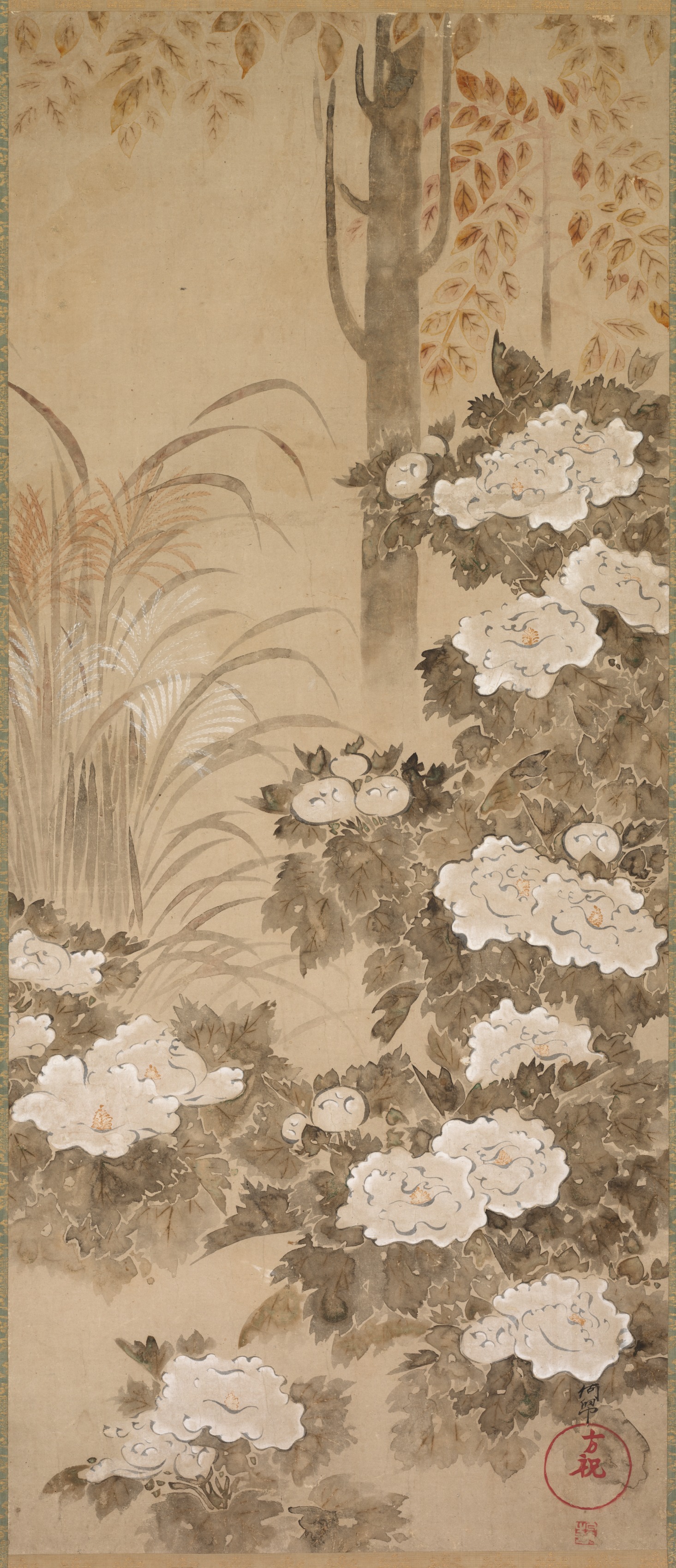
Peonies
Tatebayashi Kagei (Japanese, active mid-1700s)
mid 1700s
- Medium
- hanging scroll; ink and color on paper
- Classification
- Painting
- Dimensions
- Painting only: 90.9 x 36.2 cm (35 13/16 x 14 1/4 in.)
- Culture
- Japan, Edo period (1615–1868)
- Museum
- Cleveland Museum of Art, Japanese Art
- Credit line
- Worcester R. Warner Collection
- Rights
- Public domain (CC0), as the museum states it.
- Who can see it
- Little Ones profiles and older: it shows gentle subjects for the very young. How works are placed
View at the Cleveland Museum of Art
About this work
A proliferation of white tree peonies dominates this composition. Behind them are tall, feathery-topped susuki grasses and leafy deciduous trees. Tatebayashi Kagei restricted his palette to ink with red and white color, along with sparing use of green in the peony leaves and the blades of grass. He made generous use of the “dripping-in” (tarashikomi) technique, layering pooled ink and color, in the peony leaves. The areas left in reserve create the impression of insect-eaten or late season foliage.