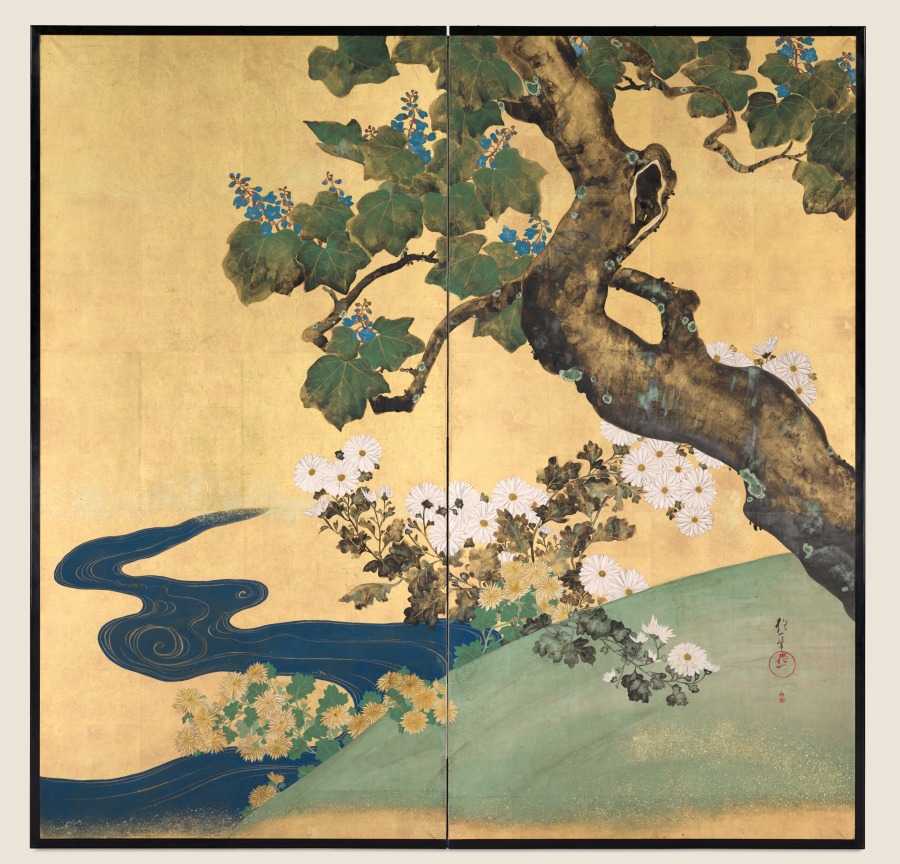
Paulownias and Chrysanthemums
Sakai Hōitsu (Japanese, 1761–1828)
early 1800s
- Medium
- Two-panel folding screen; ink and color on gilded paper
- Classification
- Painting
- Dimensions
- Image: 152.7 x 154.9 cm (60 1/8 x 61 in.); Overall: 157.5 x 158.5 cm (62 x 62 3/8 in.)
- Culture
- Japan, Edo period (1615–1868)
- Museum
- Cleveland Museum of Art, Japanese Art
- Credit line
- Gift of the American Foundation for the Maud E. and Warren H. Corning Botanical Collection
- Rights
- Public domain (CC0), as the museum states it.
- Who can see it
- Little Ones profiles and older: it shows gentle subjects for the very young. How works are placed
View at the Cleveland Museum of Art
About this work
In this screen, Sakai Hōitsu expertly deployed a painting technique called “dripping-in” (tarashikomi). Ink and color dripped on the surface, and allowed to pool there, created the illusionistic effect of lichen-dotted tree bark and twisted chrysanthemum leaves. Paulownia and chrysanthemum are signifiers of late spring and early autumn as well as emblems of the Japanese imperial house. Paulownia also has medicinal properties and associations with fortitude, while chrysanthemum symbolizes good government.