Window mode follows your eyes with your camera, in this browser only: no picture or position leaves your device.
Amitābha Triad
possibly 1400s
- Medium
- Hanging scroll; ink and color on silk
- Classification
- Painting
- Dimensions
- Painting: 95.3 x 50.2 cm (37 1/2 x 19 3/4 in.); Overall with knobs: 196.2 x 73.3 cm (77 1/4 x 28 7/8 in.)
- Culture
- China, Ming dynasty (1368–1644)
- Museum
- Cleveland Museum of Art, Chinese Art
- Credit line
- Gift of Mr. and Mrs. Warren H. Corning, Mr. and Mrs. Herbert F. Leisy, Mr. and Mrs. Oscar J. Lange, and Leon Fletcher Jr.
- Rights
- Public domain (CC0), as the museum states it.
- Who can see it
- Teens profiles and older: its museum says too little about what it shows to place it for younger viewers. How works are placed
View at the Cleveland Museum of Art
About this work
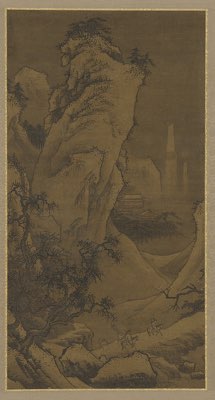
This hanging scroll illustrates an apparition of Buddha Amitābha (阿彌陀 in Chinese) and two attendant bodhisattvas, in the midst of colorful light and swirling clouds. The one who carries a miniature image of Amitābha in its jeweled crown is Avalokiteśvara (觀音 in Chinese); the other who carries a flower vase is Mahāsthāmaprāpta (大勢至 in Chinese).
Previously, this work was identified as a rare example of a Korean Buddhist painting from the early Joseon period. In contrast to surviving Korean works from this time the scroll stands out for its fine details. However, other elements such as the striped almond-shaped halo that encircles the main Buddha, firm red lines that define each deity’s facial features, and the flowing garments may identify it as an early Ming period Chinese Buddhist painting.