Window mode follows your eyes with your camera, in this browser only: no picture or position leaves your device.
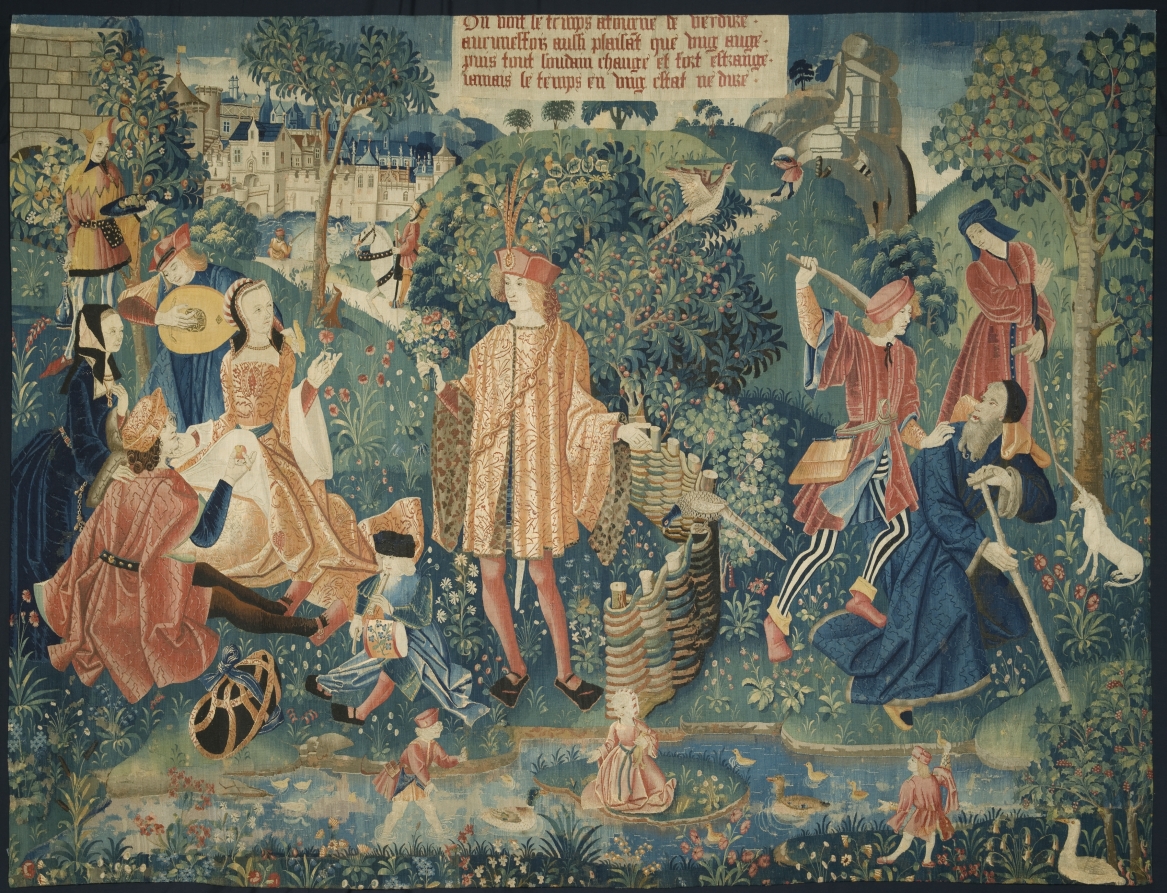
Time (from Chateau de Chaumont set)
1512–15
- Medium
- silk and wool; tapestry weave
- Classification
- Tapestry
- Dimensions
- Overall: 326.6 x 434.1 cm (128 9/16 x 170 7/8 in.)
- Culture
- France, Lyon(?), early 16th century
- Museum
- Cleveland Museum of Art, Textiles
- Credit line
- Leonard C. Hanna Jr. Fund
- Rights
- Public domain (CC0), as the museum states it.
- Who can see it
- Teens profiles and older: its museum says too little about what it shows to place it for younger viewers. How works are placed
View at the Cleveland Museum of Art
About this work
Pierre Sala, who likely commissioned the set, is portrayed as the richly attired central figure offering a bouquet, a symbol of knowledge, to Éléonore, his daughter. Éléonore is pregnant, revealed by her upturned skirt and the persimmon in her husband Hector’s hand. Hector’s mother, Marguerite, in dark attire, will wed the widowed Sala in 1519. They appear in front of the royal chateau of Blois. The figures at the right convey Sala’s advice to his children. Time (the old man with the staff) with Clio, the Muse of History, standing on his shoulders, is being attacked by a Herculean youth wielding a stick. With this allegory, Sala is explaining that youth is ignorant of the complexities of life and time. The small unicorn at the far right represents the soul. The verse in Old French at the top refers to changing time: One sees Time adorned with green foliage, Sometimes as pleasant as an angel, Then suddenly change and become quite strange. Never does Time persist in one state.