Window mode follows your eyes with your camera, in this browser only: no picture or position leaves your device.
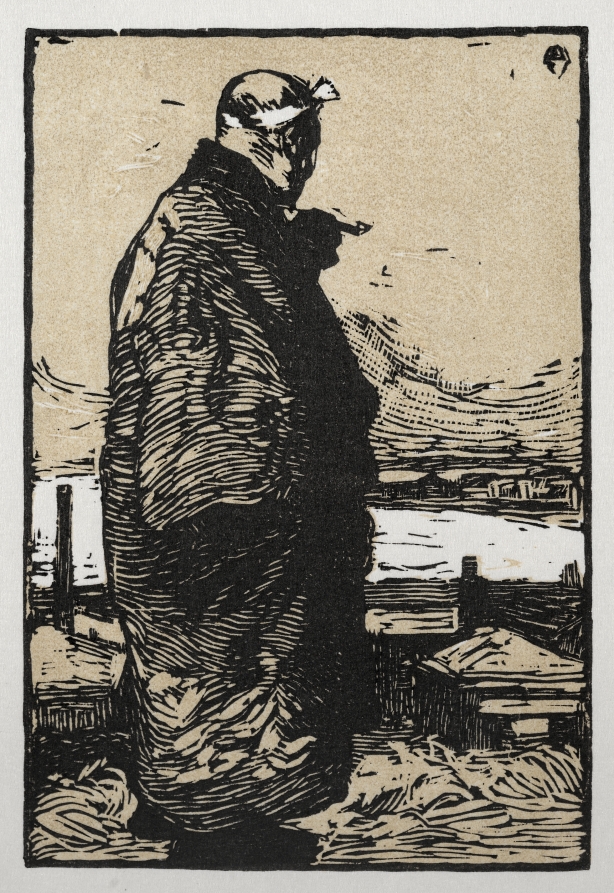
Fisherman
Yamamoto Kanae (Japanese, 1882–1946)
1906
- Medium
- woodcut
- Classification
- Culture
- Japan, Meiji period (1868–1912)
- Museum
- Cleveland Museum of Art, Japanese Art
- Credit line
- Anonymous gift in memory of Paul O. Cartun
- Rights
- Public domain (CC0), as the museum states it.
- Who can see it
- Tweens profiles and older: its subjects are known and suit older children. How works are placed
View at the Cleveland Museum of Art
About this work
This modest print marks the beginning of the sosaku-hanga movement which encouraged artists to carve and print woodblocks themselves. Fisherman, featured in the art and literary magazine Myojo (Morning Star) in 1904, accompanied an article describing Yamamoto’s revolutionary defiance of the traditional separation between the originator of the design and the artisans who execute the print, elevating woodcuts to the level of fine art. The print is also unmistakably modern in the simple, poignant depiction of the old man of the sea and in the artist’s deliberate retention of traces left by the gouge that cut the block. From the mid-19th century, when European and American artists first discovered ukiyo-e prints, Japanese pictorial conventions had a major influence on Western art. In the same way, when American naval officer Matthew Perry arrived in Japan in 1853, ending the island’s 200 years of seclusion, Japanese artists began to emulate aspects of European art. Yamamoto was impacted by British printmaker William Nicholson, who in turn had derived his bold style of a flat figure against an unmodulated background from Japanese woodcuts.