Window mode follows your eyes with your camera, in this browser only: no picture or position leaves your device.
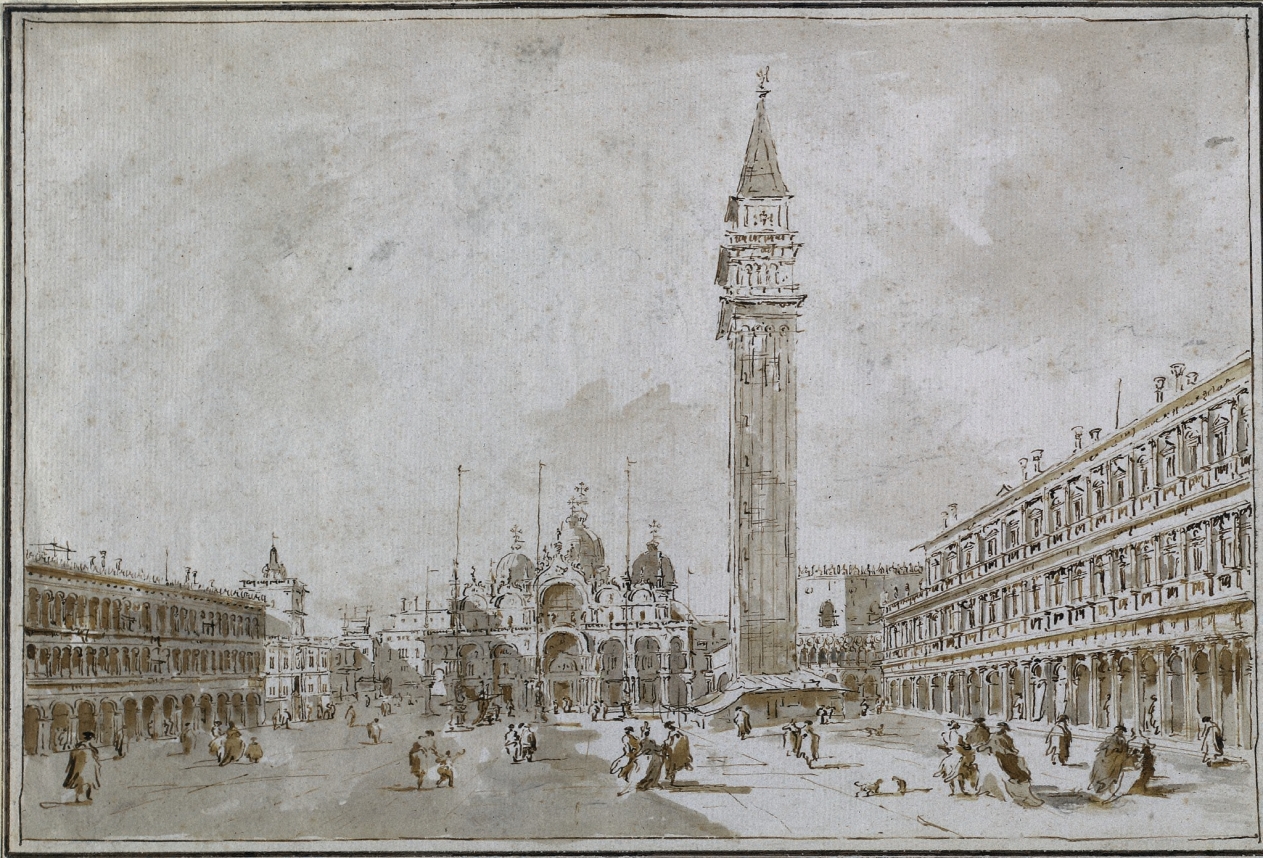
Piazza San Marco, Venice
Francesco Guardi (Italian, 1712–1793)
1780s
- Medium
- pen and brown ink, brush and brown wash, with brush and gray wash (possibly chalk) and traces of black chalk, framing lines in brown and black ink
- Classification
- Drawing
- Dimensions
- Sheet: 31.3 x 46.5 cm (12 5/16 x 18 5/16 in.)
- Culture
- Italy, Venice
- Museum
- Cleveland Museum of Art, Drawings
- Credit line
- John L. Severance Fund
- Rights
- Public domain (CC0), as the museum states it.
- Who can see it
- Teens profiles and older: its museum says too little about what it shows to place it for younger viewers. How works are placed
View at the Cleveland Museum of Art
About this work
The plaza known as the Piazza San Marco in Venice was as popular among tourists in the 1700s as it is today, and the painter Francesco Guardi provided the wealthiest of these visitors with both painted and drawn images of it. The Cleveland drawing is one of a number by Guardi that depict the same view, showing the facade of the Basilica of San Marco at the far end, the campanile (bell tower), and the Procuratie Nuove, the building seen in perspective at the right. This drawing was likely executed in Guardi’s studio, perhaps from a model made on-site using a camera obscura to capture the wide-angle viewpoint of the square. Traces of black chalk indicate where Guardi carefully worked out the arrangement and perspective of the buildings before delineating them with staccato strokes of his pen, imparting freshness and a sketchlike immediacy to his composition. His painterly handling of brown wash bathes the square in dramatic shadow. The square is populated by stock figures who take leisurely strolls under the late afternoon sun; yet the protagonist of the painting could be said to be Venice itself—the city known as La Serenissima (the Most Serene).