Window mode follows your eyes with your camera, in this browser only: no picture or position leaves your device.
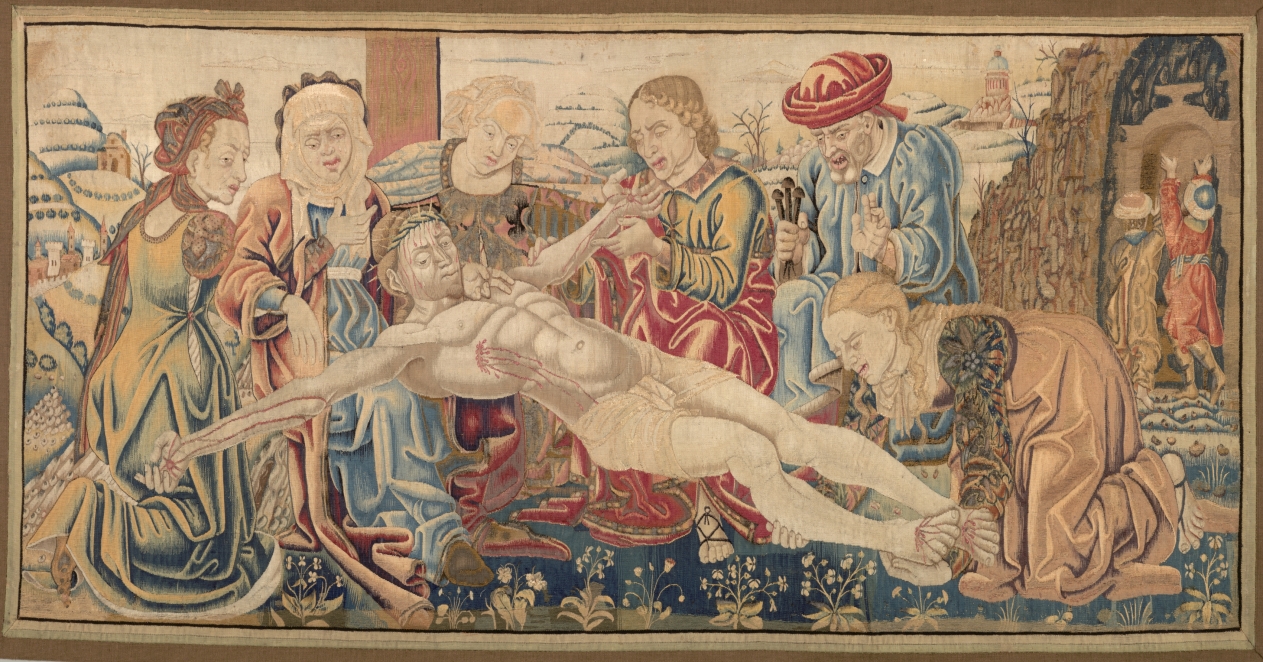
Altar Frontal with the Lamentation
attributed to Cosimo Tura (Italian, c. 1430–1495)
woven in the workshop of Rubinetto de Francia (Italian, active 1457–1483)
c. 1474
- Medium
- Wool, silk, gold and silver threads
- Classification
- Tapestry
- Dimensions
- Overall: 104.2 x 199.4 cm (41 x 78 1/2 in.)
- Culture
- Italy, Ferrara
- Museum
- Cleveland Museum of Art, Textiles
- Credit line
- John L. Severance Fund
- Rights
- Public domain (CC0), as the museum states it.
- Who can see it
- Teens profiles and older: its subject is for older viewers (war, death, the Passion, drink or the like). How works are placed
View at the Cleveland Museum of Art
About this work
A decorative textile suspended along the altar’s entire front, an altar frontal was often embellished with gold and silver threads, as seen here. This rare example depicts the lamentation of Christ, a common subject in Christian art in which the body of Christ is mourned after its removal from the cross. This version is highly acclaimed for its emotional intensity. Christ’s body is arranged in the shape of the cross, his shoulder rests on the Virgin’s knees, Saint John the Evangelist cradles his left arm, and Mary Magdalene supports his feet. Joseph of Arimathea carries the three nails with which Christ was crucified. This altar cloth was designed by Cosimo Tura who was employed at the court of Ercole I d’Este, duke of Ferrara, as a painter, illuminator, and tapestry designer between 1475 and 1484. His design was woven by Rubinetto di Francia, who was head of a large tapestry workshop at Ercole’s court. The subject of the design would imply its use during the Easter season.