Window mode follows your eyes with your camera, in this browser only: no picture or position leaves your device.
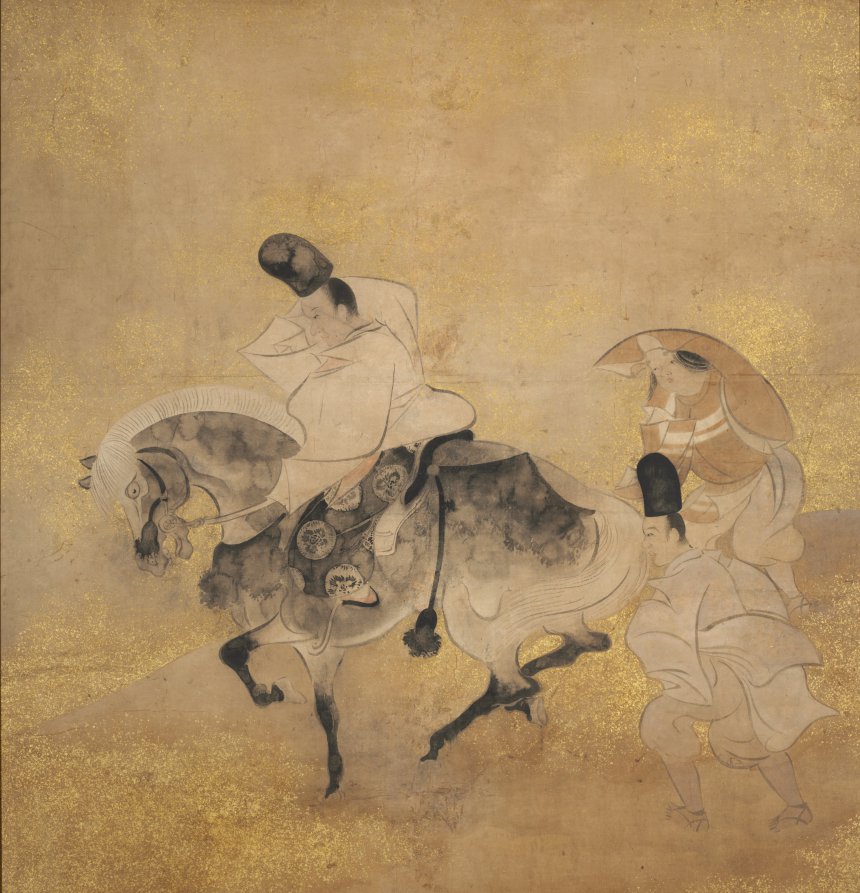
Crossing at Sano
studio of Tawaraya Sōtatsu (Japanese, c. 1570–c. 1640)
c. 1600–1640
- Medium
- Hanging scroll mounted as a single-panel screen; ink, color, and gold on paper
- Classification
- Painting
- Dimensions
- Overall: 161.7 x 139.2 x 46.3 cm (63 11/16 x 54 13/16 x 18 1/4 in.); Diameter of base: 46.3 cm (18 1/4 in.); Painting only: 125.9 x 121.4 cm (49 9/16 x 47 13/16 in.); with frame: 151.9 x 130.1 x 3.2 cm (59 13/16 x 51 1/4 x 1 1/4 in.)
- Culture
- Japan, Edo period (1615–1868)
- Museum
- Cleveland Museum of Art, Japanese Art
- Credit line
- John L. Severance Fund
- Rights
- Public domain (CC0), as the museum states it.
- Who can see it
- Teens profiles and older: its museum says too little about what it shows to place it for younger viewers. How works are placed
View at the Cleveland Museum of Art
About this work
Like many paintings from the Sōtatsu studio, a Kyoto-based atelier that ran the shop Tawaraya, this one is done in ink, mineral colors, and gold, and is formally reminiscent of 12th- and 13th-century paintings associated with the Japanese aristocracy. It depicts a man on horseback with two attendants crossing a bridge that once spanned the Kino River in Sano in eastern Wakayama Prefecture. The composition was inspired by a poem by Fujiwara no Teika (1162–1241) that translates as follows:
I stop my horse, but there is no shelter as I brush off my sleeves at Sano Crossing in the evening snow.