Window mode follows your eyes with your camera, in this browser only: no picture or position leaves your device.
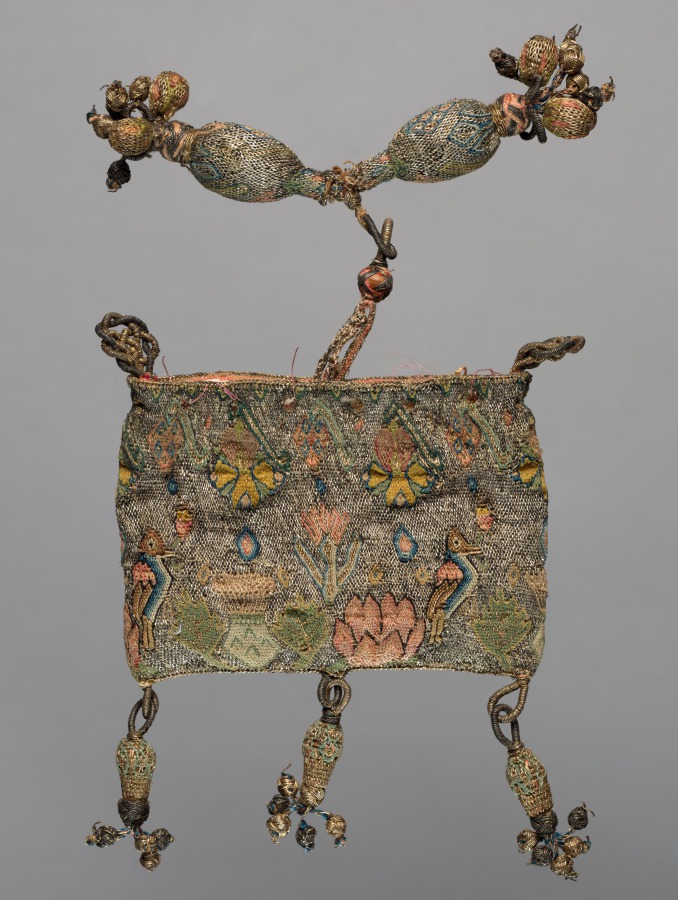
Purse
early 1600s
- Medium
- embroidery; silk and silver filé on linen ground
- Classification
- Embroidery
- Dimensions
- Overall: 6.5 x 9.5 cm (2 9/16 x 3 3/4 in.)
- Culture
- England, early 17th century
- Museum
- Cleveland Museum of Art, Textiles
- Credit line
- Gift of The Textile Arts Club
- Rights
- Public domain (CC0), as the museum states it.
- Who can see it
- Teens profiles and older: its museum says too little about what it shows to place it for younger viewers. How works are placed
View at the Cleveland Museum of Art
About this work
According to Elizabethan embroidery scholar Jacqui Carey, this purse and its trimmings are typical of a ‘sweet bag’, though it is missing its handle and its drawstring is damaged. The term ‘sweet bag’ was popularized in George Wingfield Digby’s 1963 publication on Elizabethan embroidery; Digby used the term to describe small English purses dating from the 1500s and 1600s. The body of the purse is not the usual embroidered linen. Instead, it is a form of tubular warp-wrapping, a larger version of the structure and design found on tassels typical of the period. The body of the purse is made from a spiraling weft wrapped with multiple warp threads. It is assumed that it was made over a cylindrical form that was removed when the work was complete. The motifs are created by shifting the colored threads. Black silk warp threads that have since disintegrated expose the spiraling weft.












