Window mode follows your eyes with your camera, in this browser only: no picture or position leaves your device.
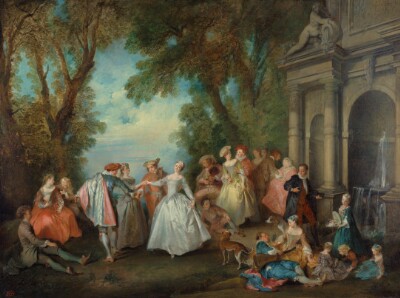
Dancers in a Pavilion
Jean-Baptiste Pater (French, 1695–1736)
1720s
- Medium
- oil on canvas
- Classification
- Painting
- Dimensions
- Framed: 79.5 x 70 x 10.5 cm (31 5/16 x 27 9/16 x 4 1/8 in.); Unframed: 55.3 x 47 cm (21 3/4 x 18 1/2 in.)
- Culture
- France
- Museum
- Cleveland Museum of Art, European Painting and Sculpture
- Credit line
- Gift of Commodore Louis D. Beaumont
- Rights
- Public domain (CC0), as the museum states it.
- Who can see it
- Tweens profiles and older: its subjects are known and suit older children. How works are placed
View at the Cleveland Museum of Art
About this work
Jean-Baptiste Pater was the sole student of the early 18th-century artist Antoine Watteau (1684–1721). Upon Watteau's death, Pater finished some of his teacher's compositions and copied them for reproduction. Due to this association, Pater was in the position to capitalize on the popularity of the fête galante genre invented by Watteau. This genre was based on the fêtes held by the aristocracy to escape the tedium of life at the French court, and depict the same amusements: conversation, music, dance, and the pursuit of love. Dancers in a Pavilion is a pastiche of several works by Watteau. The couple in this painting is most likely performing the minuet, which was considered the most flirtatious of dances.