Window mode follows your eyes with your camera, in this browser only: no picture or position leaves your device.
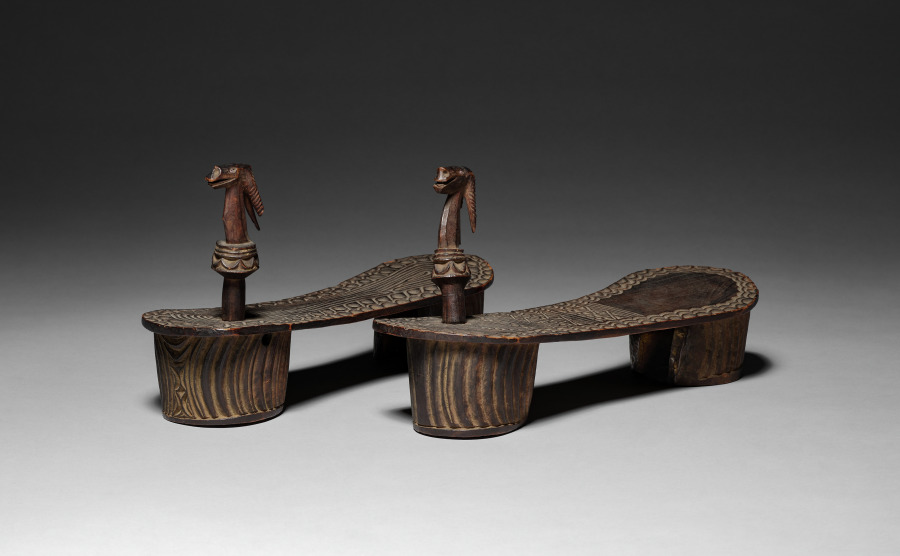
Sandals (mitalawanda / mitawanda) or Clogs (kiatu cha mti)
c. 1800s
- Medium
- Wood and glass beads
- Classification
- Garment
- Dimensions
- Overall: 6 x 10.2 cm (2 3/8 x 4 in.); Part 2: 4.5 x 12.4 cm (1 3/4 x 4 7/8 in.); Part 3: 6 x 9.5 cm (2 3/8 x 3 3/4 in.); Part 4: 3.2 x 12.1 cm (1 1/4 x 4 3/4 in.)
- Culture
- Africa, Central Africa, Democratic Republic of Congo, unidentified carver
- Museum
- Cleveland Museum of Art, African Art
- Credit line
- Educational Purchase Fund
- Rights
- Public domain (CC0), as the museum states it.
- Who can see it
- Tweens profiles and older: its subjects are known and suit older children. How works are placed
View at the Cleveland Museum of Art
About this work
Common in the Indian Ocean region, wooden sandals changed meaning across place and time. This pair’s base elevates the foot as the toes grip an antelope-shaped peg (msuruaki). Crisp geometric sole designs suggest they were rarely worn. East African elites and merchants once had exclusive rights to wooden shoes, wearing elaborate ones only for portraits. Formerly enslaved people living along the coast wore simpler ones from the 1840s onward, adopting elite footwear to assert their liberation. However, slave traders like the Zanzibari “Tippu Tip” (c. 1832–1905) likely brought mitalawanda to Central Africa; stylistic elements of this pair hail from that region.