Window mode follows your eyes with your camera, in this browser only: no picture or position leaves your device.
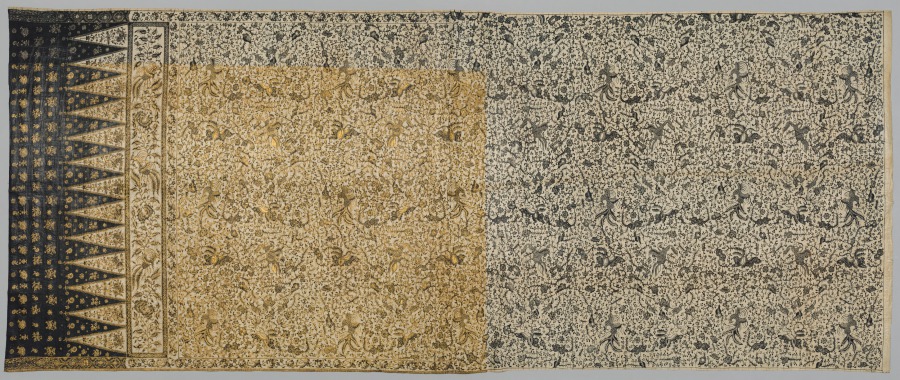
Sarong
1800s
- Medium
- batik and applied gold, cotton
- Classification
- Textile
- Dimensions
- Overall: 276.8 x 113 cm (109 x 44 1/2 in.)
- Culture
- Indonesia, Java, North Coast, 19th century
- Museum
- Cleveland Museum of Art, Textiles
- Credit line
- Purchase from the J. H. Wade Fund
- Rights
- Public domain (CC0), as the museum states it.
- Who can see it
- Tweens profiles and older: its subjects are known and suit older children. How works are placed
View at the Cleveland Museum of Art
About this work
This sarong, overlaid with gold leaf (or gold dust), would have been worn for high ceremonial occasions and festivals. The gold has been applied only to the parts of the sarong that would show when draped, and on one side only. The delicate, linear design with Chinese phoenixes, butterflies, and leafy tendrils is one of the characteristic styles of batiks made in cities along the north coast of Java. The "tumpal" (triangle) design of the wide end border (a pan-Southeast Asian motif that commonly occurs on northern Javanese batiks) seems to have symbolized growth and fertility as well as the sacred mountain, Meru.