Window mode follows your eyes with your camera, in this browser only: no picture or position leaves your device.
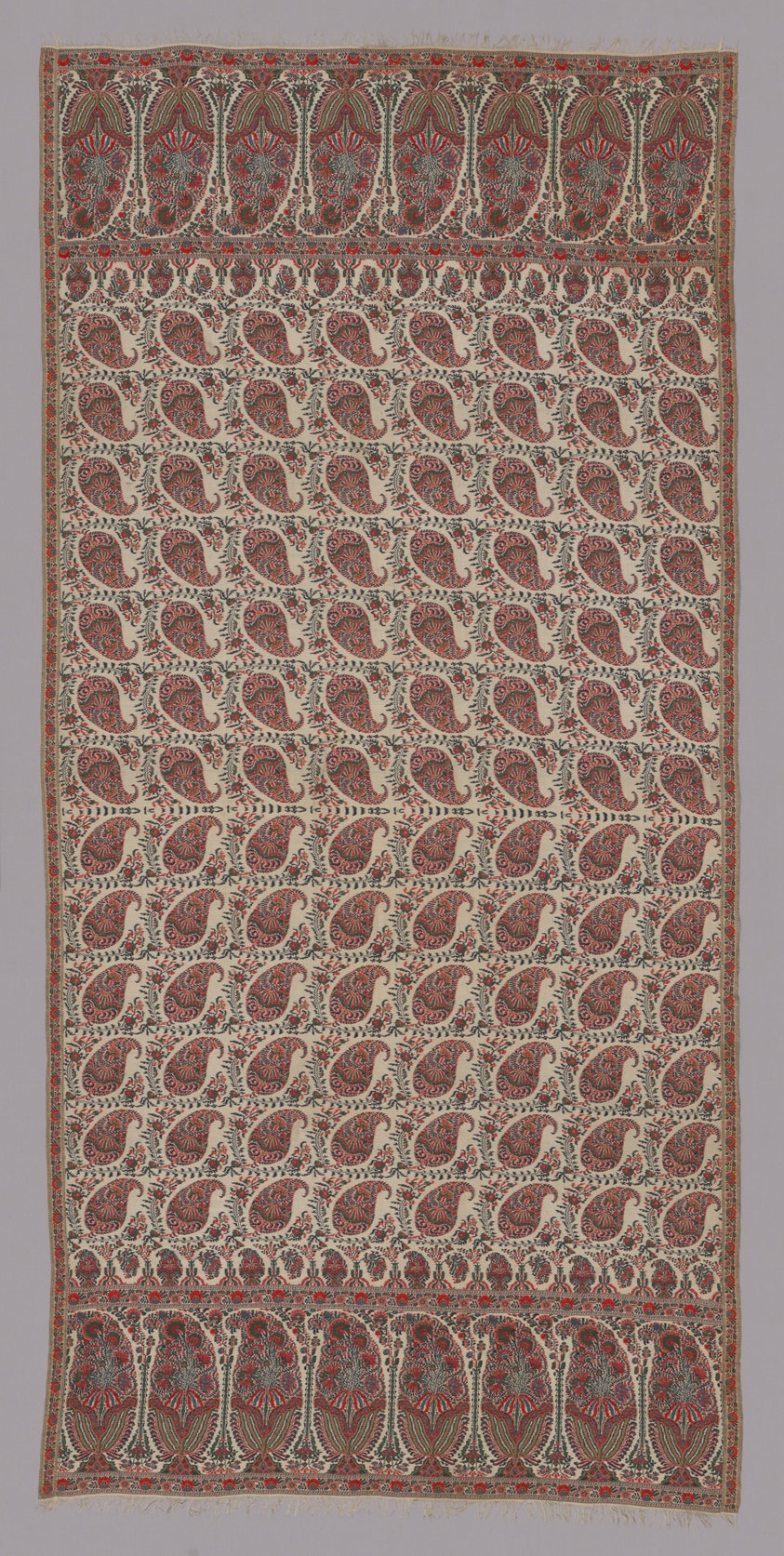
Woman's Long Shawl
1820s
- Medium
- Silk, cotton, and wool, warp-float faced 3:1 'S' twill weave with supplementary patterning wefts bound in weft-float faced 1:3 'S' twill interlacings; attached side borders of 2:2, 2:2, 1:3, 2:2...'Z' composite twill weaves with…
- Classification
- Costume and Accessories
- Dimensions
- 264.2 × 124.2 cm (104 × 48 7/8 in.); Center repeat: 12.7 × 14.5 cm (5 × 5 3/4 in.)
- Culture
- Norwich
- Museum
- Art Institute of Chicago, Textiles
- Credit line
- Purchased with funds provided by Mrs. Julian Armstrong, Jr.; Textile Purchase Fund
- Rights
- Public domain (CC0), as the museum states it.
- Who can see it
- Tweens profiles and older: its subjects are known and suit older children. How works are placed
View at the Art Institute of Chicago
About this work
These boldly patterned shawls illustrate the broad appeal of the buta, or paisley, pattern. The Jacquard mechanism, a patterning technology introduced in the first decade of the 1800s, enabled European manufacturers to create increasingly complex variations on the paisley motif. Although this technology allowed for faster weaving, European companies never successfully reproduced the delicacy of the hand-woven shawls from Kashmir. British- and French-made shawls tended to be thicker and heavier and the designs were arguably less refined than the original Kashmir garments.
Description © Art Institute of Chicago, CC BY 4.0