Window mode follows your eyes with your camera, in this browser only: no picture or position leaves your device.
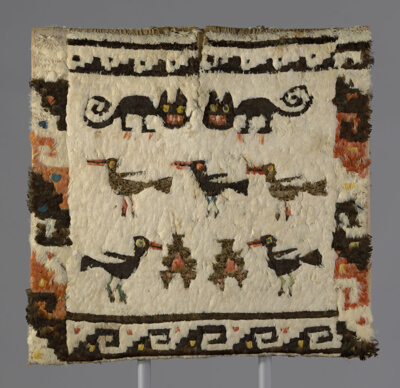
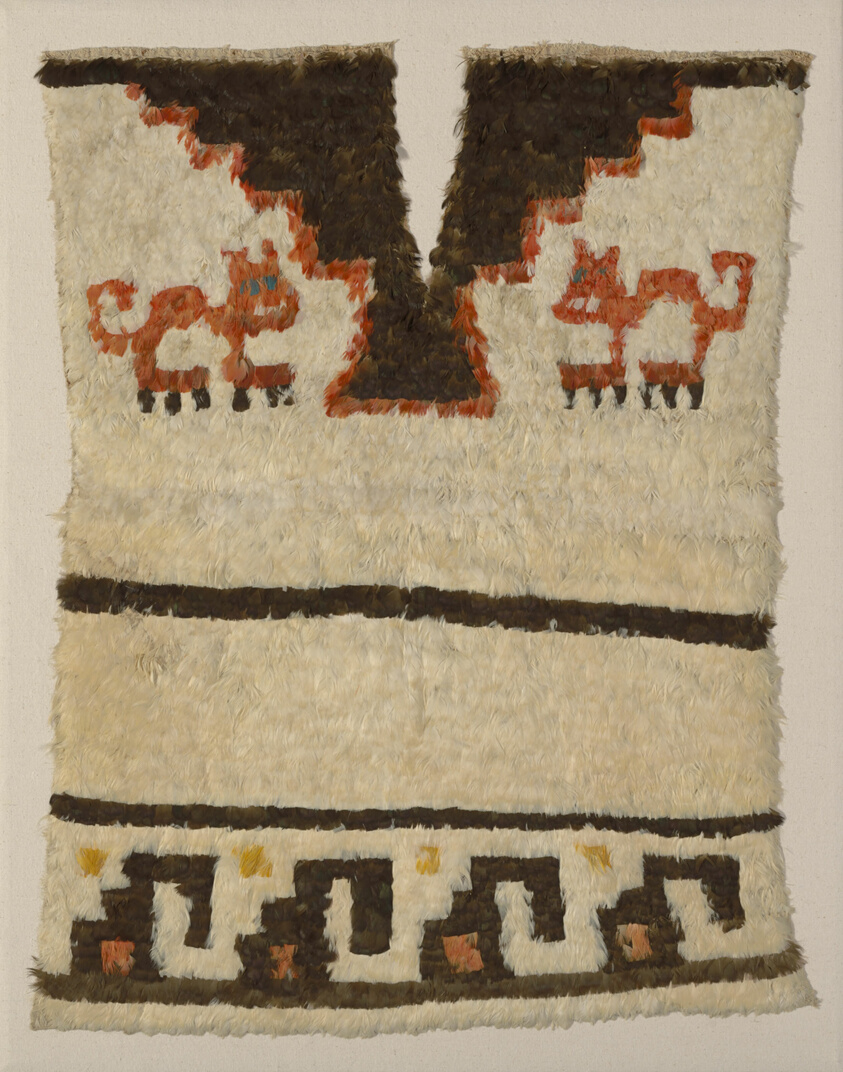
Half of a Tabard (Open-sided Tunic)
Chimú (Peru, south coast, Possibly Nazca Valley)
1400-1532
- Medium
- Cotton, plain weave, with double warps and single wefts; embellished with feathers (likely from great or snowy egrets, Muscovy ducks, Chilean flamigos, and macaws) knotted and attached with cotton in back stitches
- Classification
- Costume and Accessories
- Dimensions
- 88.9 × 70.2 cm (35 × 27 5/8 in.)
- Culture
- Peru
- Museum
- Art Institute of Chicago, Textiles
- Credit line
- Kate S. Buckingham Endowment
- Rights
- Public domain (CC0), as the museum states it.
- Who can see it
- Tweens profiles and older: its subjects are known and suit older children. How works are placed
View at the Art Institute of Chicago
About this work
This man’s garment was woven like a Chimú textile made on the north coast of Peru, but its feline motifs are similar to those created by Ica or Chincha artists of the south coast. It may have been produced when these cultures were subjugated by the Inca Empire. Unfortunately, few similar brown-and-white feathered tunics are currently known, making comparative studies difficult. The Art Institute of Chicago stewards this one as well as a second example, and the Linden Museum in Stuttgart preserves a third. All three were collected around 1900 by a German doctor living in Lima named Eduard Gaffron.
Description © Art Institute of Chicago, CC BY 4.0