Window mode follows your eyes with your camera, in this browser only: no picture or position leaves your device.
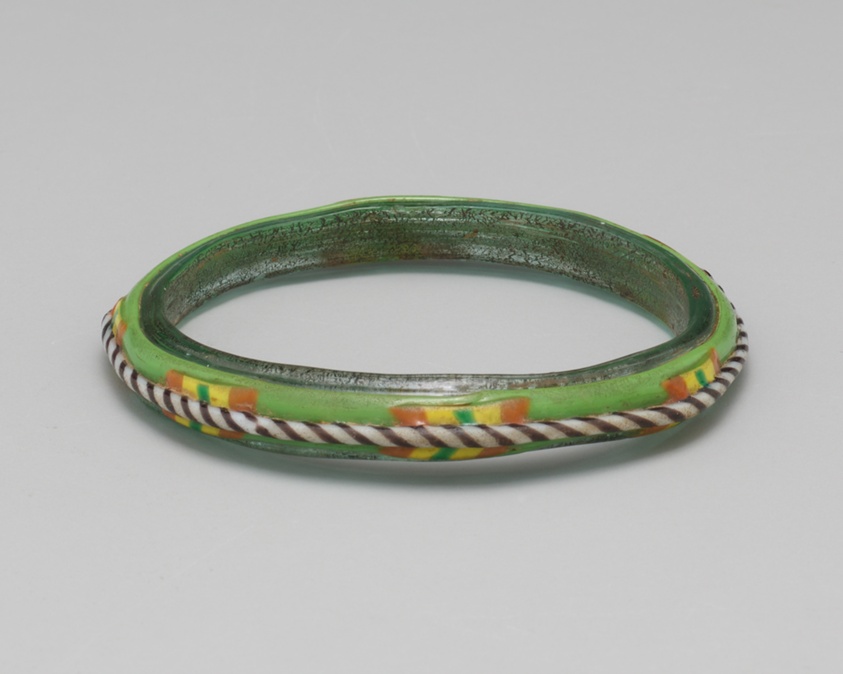
Bracelet
14th-15th century
- Medium
- Glass
- Classification
- Costume and Accessories
- Dimensions
- 0.8 × 6.4 × 6.4 cm (11 × 2 1/2 × 2 1/2 in.)
- Museum
- Art Institute of Chicago, Arts of Africa
- Credit line
- Purchased with funds provided by Henry H. Getty and Charles L. Hutchinson
- Rights
- Public domain (CC0), as the museum states it.
- Who can see it
- Tweens profiles and older: its subjects are known and suit older children. How works are placed
View at the Art Institute of Chicago
About this work
For hundreds of years, women up and down the eastern coast of Africa wore bracelets like these as highly fashionable accessories. Simple monochromatic glass bangles first became common in Egypt beginning in the Ptolemaic Period (332–30 BCE), with multiple color chips and new designs emerging during the Roman period (30 BCE–395 CE). After the arrival of Islam in the 7th century, elaborately designed bracelets became the norm. In the 17th century, artists began to add a multicolored spiral band on the outside of each bangle, seen here in black and white. Glass workshops continued to produce such bangles until the end of the 19th century.
Description © Art Institute of Chicago, CC BY 4.0