Window mode follows your eyes with your camera, in this browser only: no picture or position leaves your device.
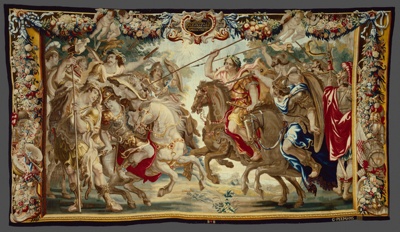
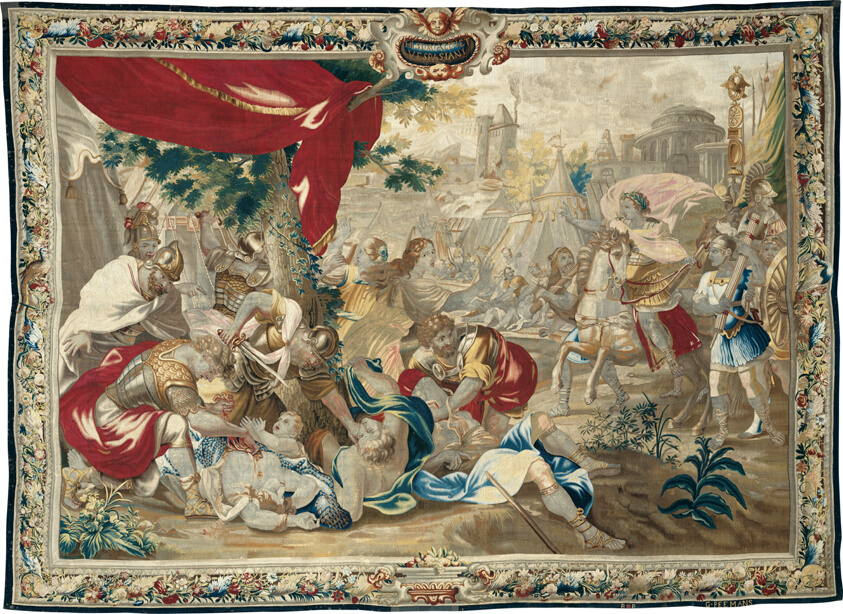
The Massacre at Jerusalem from The Story of Titus and Vespasian
Workshop of Gerard Peemans (Woven at the workshop of Gerard Peemans (1637/39–1725); Brussels)
1650/75
- Medium
- Wool and silk; slit, dovetailed, and double interlocking tapestry weave Warp: Count: 9 warps per cm; wool: S-ply of four Z-spun elements; diameters: 0.7–0.8 mm Weft: Count: varies from 20 to 38 wefts per cm; wool: S-ply of two Z-spun…
- Classification
- Textile
- Dimensions
- 514 × 367.7 cm (202 3/8 × 144 3/4 in.)
- Culture
- Brussels
- Museum
- Art Institute of Chicago, Textiles
- Credit line
- Gift of Marshall Field and Company
- Rights
- Public domain (CC0), as the museum states it.
- Who can see it
- Adult profiles and older: its museum's description or title mentions violence, death or gore. How works are placed
View at the Art Institute of Chicago
About this work
This tapestry belongs to the eight-piece Story of Titus and Vespasian suite designed by Charles Poerson, who practiced the French academic-decorative manner that supplanted the dramatic and monumental Flemish High Baroque. Poerson clearly based the series on book two of Tacitus’s The Jewish War (c. A.D. 75–79). Both Vespasian and his son Titus led the Roman troops during the First Jewish-Roman War (A.D. 66–73), a major rebellion by the Jews of Judaea against the Roman Empire. This tapestry depicts the massacre that took place at Jerusalem six months after the initial siege. The Arabian and Syrian soldiers who were part of Titus’s army slaughtered the Jews who were attempting to flee, cutting open their victims’ bellies to get the gold coins some of them had swallowed before surrendering to the Romans. Titus can by seen on horseback, in the background on the right, rushing to stop the carnage.
Description © Art Institute of Chicago, CC BY 4.0