Window mode follows your eyes with your camera, in this browser only: no picture or position leaves your device.
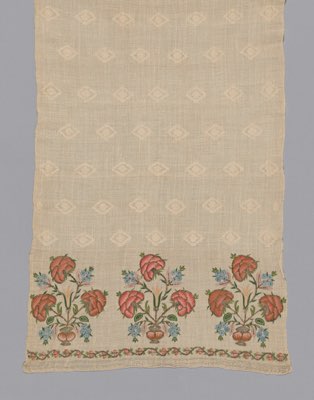
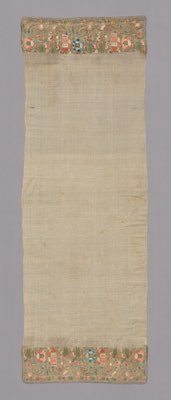
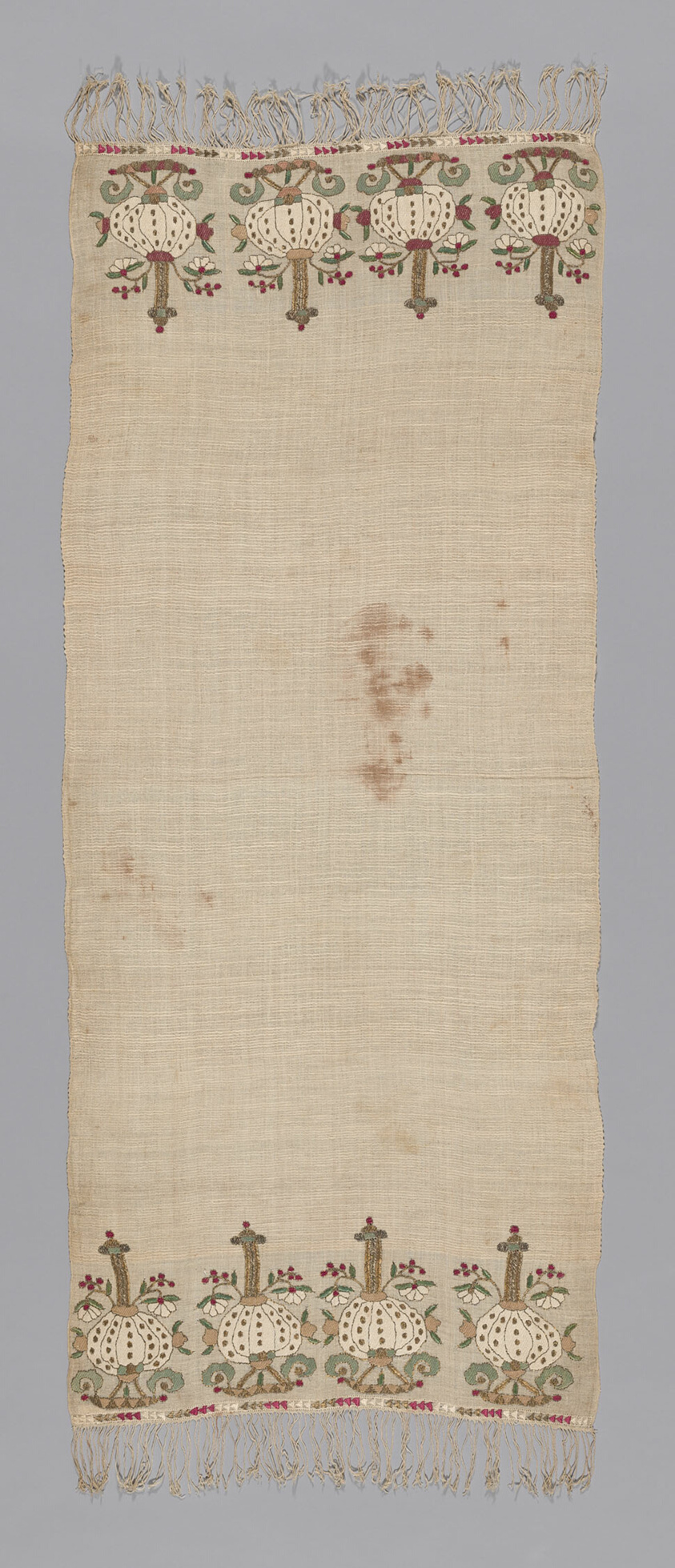
Towel or Napkin
19th century
- Medium
- Linen, plain weave; embroidered with silk; extended plied warp fringe
- Classification
- Textile
- Dimensions
- 130.8 × 48.6 cm (51 1/2 × 19 1/4 in.)
- Culture
- Turkey
- Museum
- Art Institute of Chicago, Textiles
- Credit line
- Gift of Burton Y. Berry
- Rights
- Public domain (CC0), as the museum states it.
- Who can see it
- Teens profiles and older: its museum says too little about what it shows to place it for younger viewers. How works are placed
View at the Art Institute of Chicago
About this work
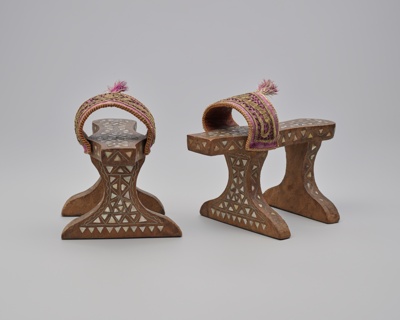
In 19th-century hammams, or public baths, bath towels and kerchiefs were some of the most popular and intricately made items. Bath towels were only embroidered on the edges, leaving the middle section bare for drying the body; here, someone embroidered stylized depictions of rosewater sprinklers, small bottles used to scent rooms and refresh guests in hammam and bath settings. Women wrapped kerchiefs on their heads as they transitioned to the cold room afterward. In hammams, women were able to showcase items from their dowries, their skillful hand embroidery, and social status with decorative bath coats, clogs, towels, and wrappers.
—Atlas Defne Erkan (Turkish), graduate student in art history, University of Edinburgh; School of the Art Institute of Chicago (BFA 2025)
Description © Art Institute of Chicago, CC BY 4.0