Window mode follows your eyes with your camera, in this browser only: no picture or position leaves your device.
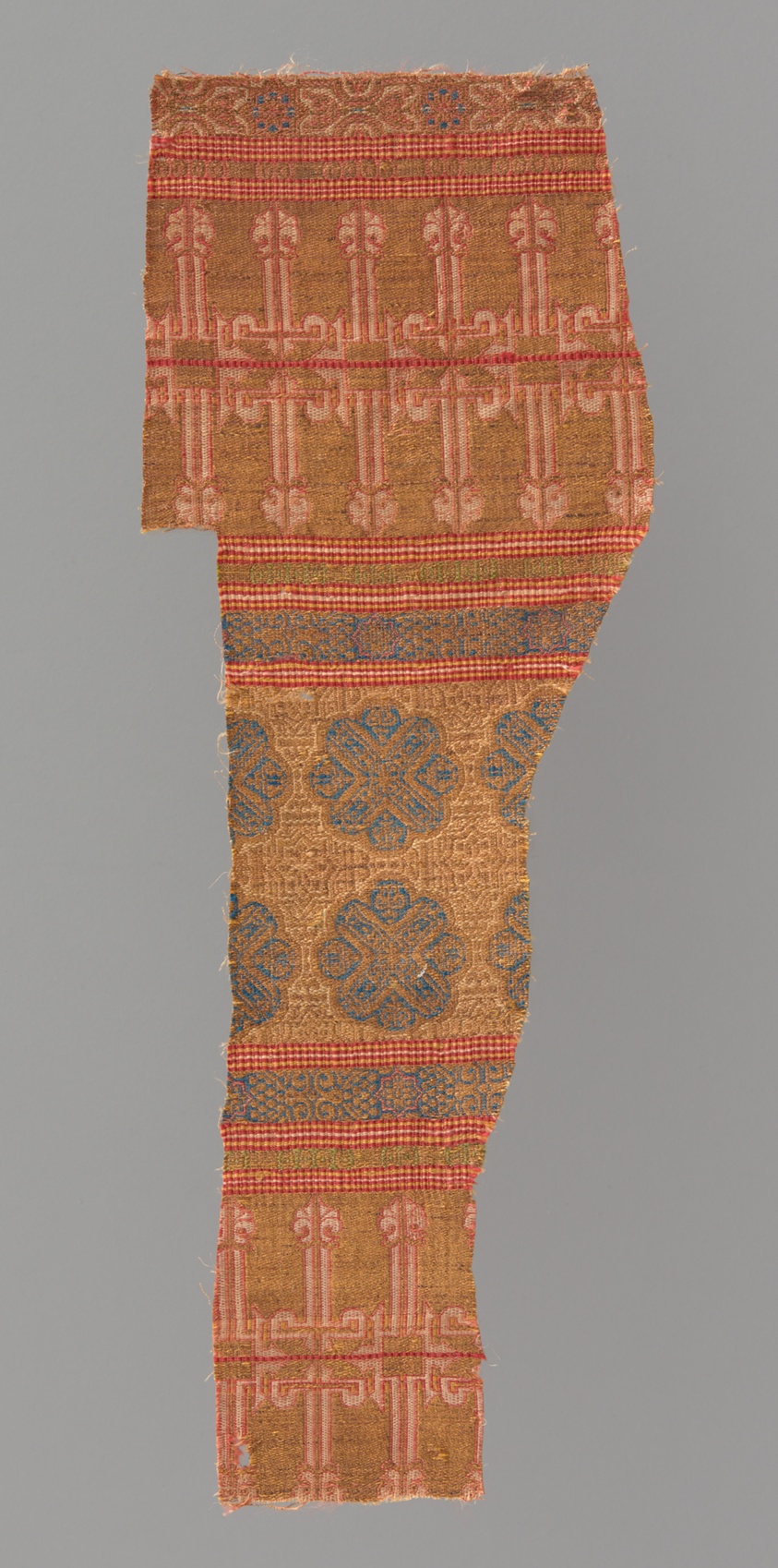
Fragment from the Mantle of Don Felipe
Villalcázar de Sirga, provence of Palencia, Kingdom of Castile (present-day Spain)
1275-1300
- Medium
- Silk and gilt-animal-substrate-wrapped silk, bands of plain weave with inner warps and complementary weft plain weave with inner warps
- Classification
- Textile
- Dimensions
- 33.9 × 12.1 cm (13 3/8 × 4 3/4 in.)
- Culture
- Villalcázar de Sirga
- Museum
- Art Institute of Chicago, Textiles
- Credit line
- Purchased with funds provided by Mrs. Chauncey B. Borland
- Rights
- Public domain (CC0), as the museum states it.
- Who can see it
- Tweens profiles and older: its subjects are known and suit older children. How works are placed
View at the Art Institute of Chicago
About this work
Luxury textiles produced in Islamic Andalucía were so highly valued by Christians living in northern Spain—and indeed throughout Europe as a whole—that they were sought by the nobility and worn not only in life but also in death. Such was the case with this woven silk fragment, found in the tomb of Don Felipe (died 1271 or 1274) and his second wife, Doña Inés de Guevara y Cisneros at the Church of Santa María la Blanca in Villalcázar de Sirga. Their tombs were set on either side of the main altar in the sanctuary of a fortress-temple dedicated to the Virgin Mary. The miraculous powers of Our Lady of Villasirga are recorded in the Cantigas de Santa Maria, a collection of songs attributed to King Alfonso X of Castile and León (ruled 1252-84), Don Felipe's brother. These works were written in Galician, a Romance language, but utilized the zajal, a poetic form of Andalusian Arabic origin.
Such cultural hybridity reflects the temper of Alfonso's lively court, in which Christians, Jews, and Muslims were active participants. Despite this climate of interchange, Christian armies fought to expand their domain during his reign and were only stopped at the border of the Islamic kingdom of…
Description © Art Institute of Chicago, CC BY 4.0