Window mode follows your eyes with your camera, in this browser only: no picture or position leaves your device.
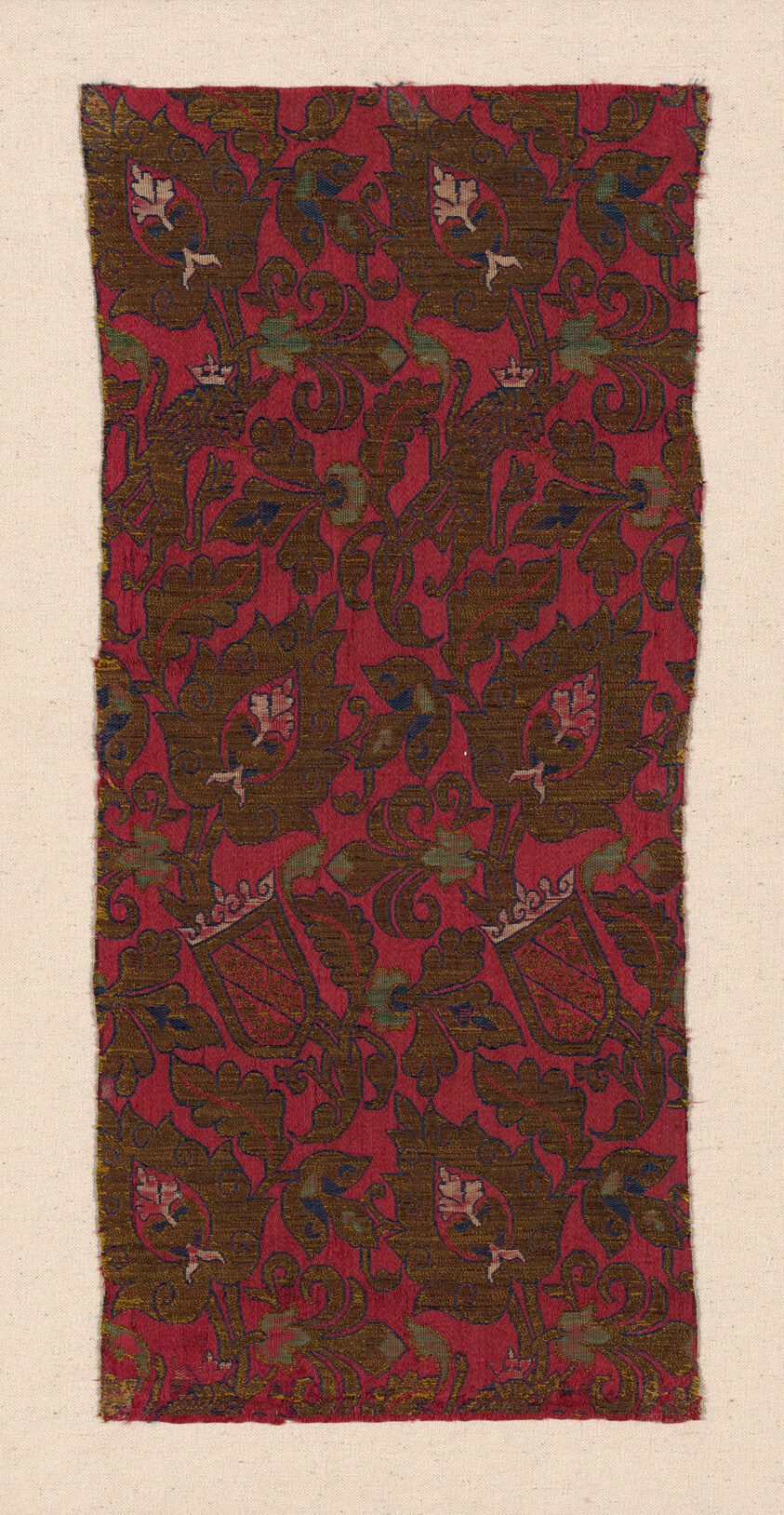
Fragment with Nasrid Coat of Arms
Probably Emirate of Granada (present-day southern Spain)
Nasrid Dynasty (ruled 1232–1492), about 1400
- Medium
- Silk and gilt-animal-substrate-wrapped silk; satin weave with secondary binding warps and supplementary patterning wefts
- Classification
- Textile
- Dimensions
- 42 × 19.7 cm (16 1/2 × 7 3/4 in.); Repeat: 31.3 × 9.6 cm (12 1/4 × 3 3/4 in.)
- Culture
- Granada province
- Museum
- Art Institute of Chicago, Textiles
- Credit line
- Purchased with funds provided by Mrs. Edwin A. Seipp
- Rights
- Public domain (CC0), as the museum states it.
- Who can see it
- Little Ones profiles and older: it shows gentle subjects for the very young. How works are placed
View at the Art Institute of Chicago
About this work
The Nasrid Dynasty ruled the kingdom of Granada in southern Spain for nearly two and a half centuries (about 1250-1500) and was the last major Muslim dynasty on the Iberian Peninsula. While the Nasrids alternated between war and uneasy armistice with Christians to the north, they forged tentative alliances with their Muslim neighbors in North Africa. Despite this rather turbulent political climate, the court at Granada played host to the great scholars and artists of the day. The royal chancery directed architecture and ornament while poet-viziers bequeathed beautiful literary works to posterity. The single most impressive monument of Nasrid rule is Granada's Alhambra, or "red castle," which boasts spectacularly intricate interiors and magnificent courtyards with gardens and fountains.
Silk, long recognized as the richest and finest fiber to be woven into cloth, is fashioned here in a floral pattern featuring prancing lions and an alternating shield-and-pomegranate motif. The shields bear the Nasrid coat of arms with a Kufic inscription declaring "Glory to Our Lord the Sultan." This text, as well as the crowns adorning the shields and lions, indicates that the fabric was used by…
Description © Art Institute of Chicago, CC BY 4.0