Window mode follows your eyes with your camera, in this browser only: no picture or position leaves your device.
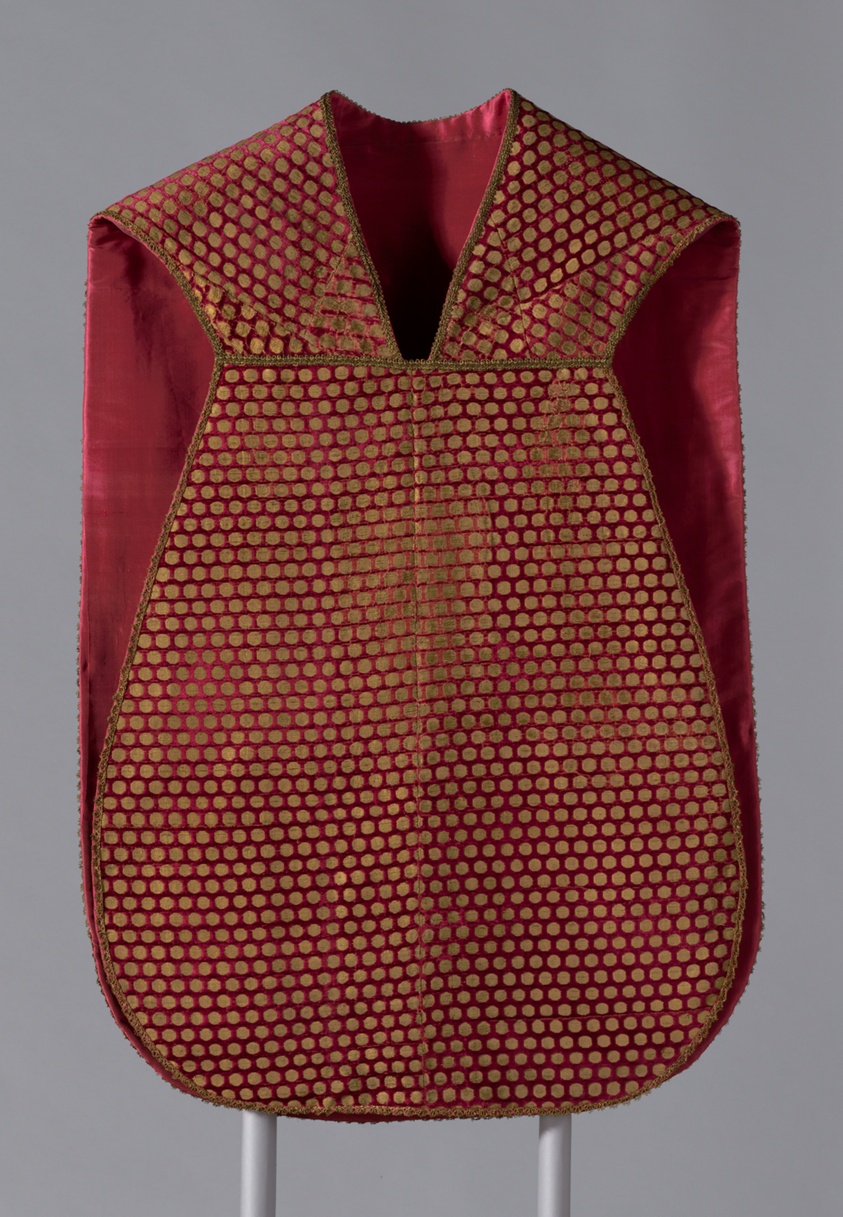
Chasuble
Tabriz, Iran (Persia)
Late 13th/14th century
- Medium
- Silk, plain weave with twill interlacings of secondary binding warps and gilt-animal-substrate-wrapped silk supplementary facing wefts; supplementary pile warps forming cut voided velvet; edged with gilt-metal-strip-wrapped silk,…
- Classification
- Textile
- Dimensions
- 107.5 × 70.6 cm (42 1/4 × 27 7/8 in.); Repeat: 3.2 × 3.2 cm (1 1/4 × 1 1/4 in.)
- Culture
- Tabriz
- Museum
- Art Institute of Chicago, Textiles
- Credit line
- Gift of Martin A. Ryerson through the Antiquarian Society
- Rights
- Public domain (CC0), as the museum states it.
- Who can see it
- Tweens profiles and older: its subjects are known and suit older children. How works are placed
View at the Art Institute of Chicago
About this work
This chasuble, a Western church vestment worn by bishops and priests during Mass, is made from red velvet patterned with staggered rows of gold disks and is a prime example of cultural exchange between the Middle East and the West. It is one of about 30 surviving pieces with this pattern, most of which are fragments. Papal and Italian church inventories establish that such fabrics were woven in the late 13th and 14th centuries. Long associated with Spain or Italy, this fabric has more recently been attributed to the eastern Islamic world, specifically Tabriz in northwestern Iran. The attribution is based on technical characteristics, inventory descriptions, and Tabriz's fame as a center for luxury textiles.
Description © Art Institute of Chicago, CC BY 4.0












