Window mode follows your eyes with your camera, in this browser only: no picture or position leaves your device.
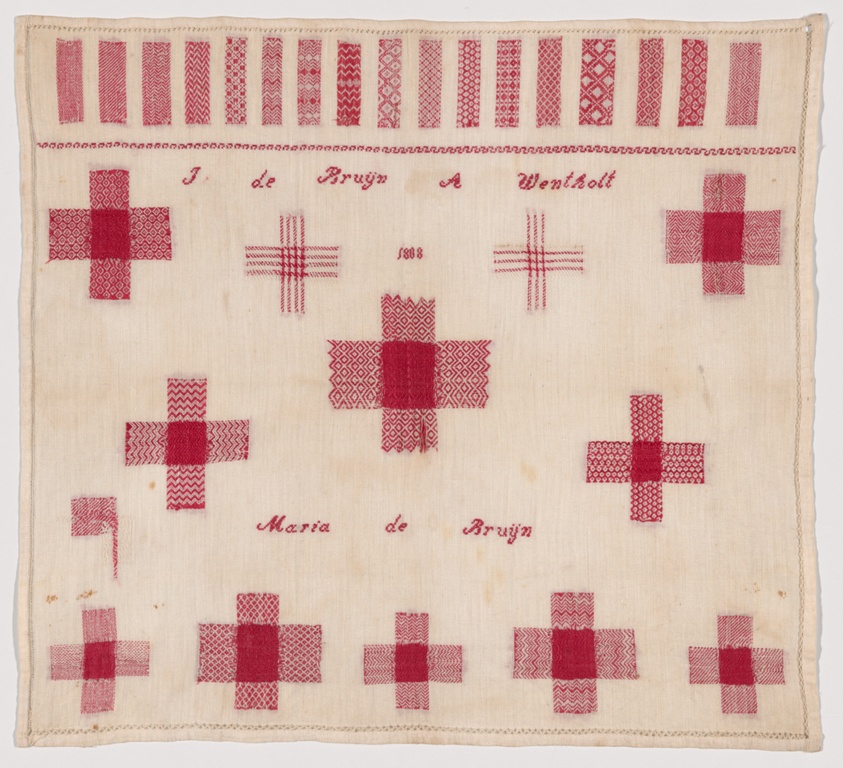
Darning Sampler
Possibly Maria de Bruÿn (Dutch, active early 19th century) (Netherlands)
1808
- Medium
- Cotton, plain weave; embroidered in darning and cross stitches
- Classification
- Textile
- Dimensions
- 33.5 × 36.7 cm (13 1/8 × 14 1/2 in.)
- Culture
- Netherlands
- Museum
- Art Institute of Chicago, Textiles
- Credit line
- Gift of Mrs. Harold Keele through the Needlework and Textile Guild
- Rights
- Public domain (CC0), as the museum states it.
- Who can see it
- Tweens profiles and older: its subjects are known and suit older children. How works are placed
View at the Art Institute of Chicago
About this work
In the early 19th century, schoolgirls in Northern Europe made darning samplers to learn the crucial skill of mending, practicing a range of embroidery and darning techniques that could extend the life of garments and household textiles. Although these repairs have a beauty all their own when made in contrasting thread, they were ultimately intended to be invisible. The use of two-colored threads allowed students to discern the underlying weave structure; students would gradually transition to using one color of thread as they gained skill.
Description © Art Institute of Chicago, CC BY 4.0