Window mode follows your eyes with your camera, in this browser only: no picture or position leaves your device.
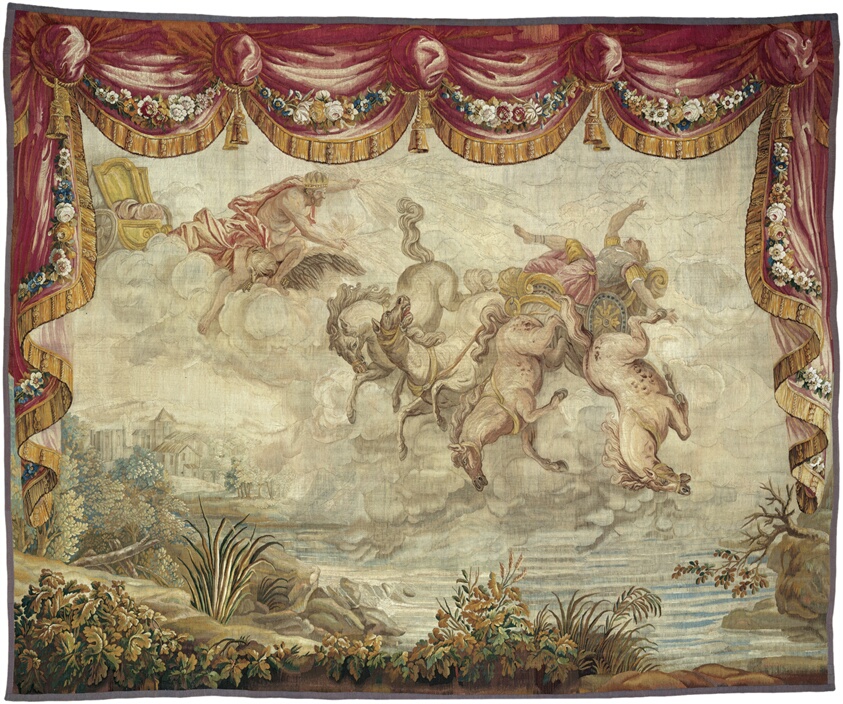
The Fall of Phaeton
Antonio Tempesta (Possibly woven at the workshop of Gabriel Babonneix (born 1756?) at the Manufacture Royale d’Aubusson; France, Aubusson)
after 1776
- Medium
- Wool and silk, slit and double interlocking tapestry weave
- Classification
- Textile
- Dimensions
- 351.2 × 286.3 cm (138 1/4 × 112 3/4 in.)
- Culture
- Aubusson
- Museum
- Art Institute of Chicago, Textiles
- Credit line
- Gift of William Deering Howe
- Rights
- Public domain (CC0), as the museum states it.
- Who can see it
- Teens profiles and older: its museum says too little about what it shows to place it for younger viewers. How works are placed
View at the Art Institute of Chicago
About this work
Phaeton’s overweening ambition to guide his father’s chariot of the sun through the sky is recorded in Ovid’s Metamorphoses, as is the disastrous outcome of his attempt, here presented in a dramatic scene that captures the tumultuous moment of Phaeton’s being struck down by a thunderbolt from Zeus. The scalloped valance and matching side curtains that frame the scene link it to The Arrival of Telemachus on Calypso’s Island. The two tapestries are part of a Story of Telemachus suite based on François Fénelon’s Adventures of Telemachus (Les Aventures de Télémaque; 1699), which was originally written as an ethical guide for the education of Louis, Duke of Burgundy (1618–1712), the grandson and heir of Louis XIV (r. 1643–1715). Phaeton’s story—particularly his death, as depicted in this tapestry—conveys the consequences of youthful intrepidity and pride, and like the tapestries’ source material, offers viewers a powerful moral lesson.
Description © Art Institute of Chicago, CC BY 4.0