Window mode follows your eyes with your camera, in this browser only: no picture or position leaves your device.
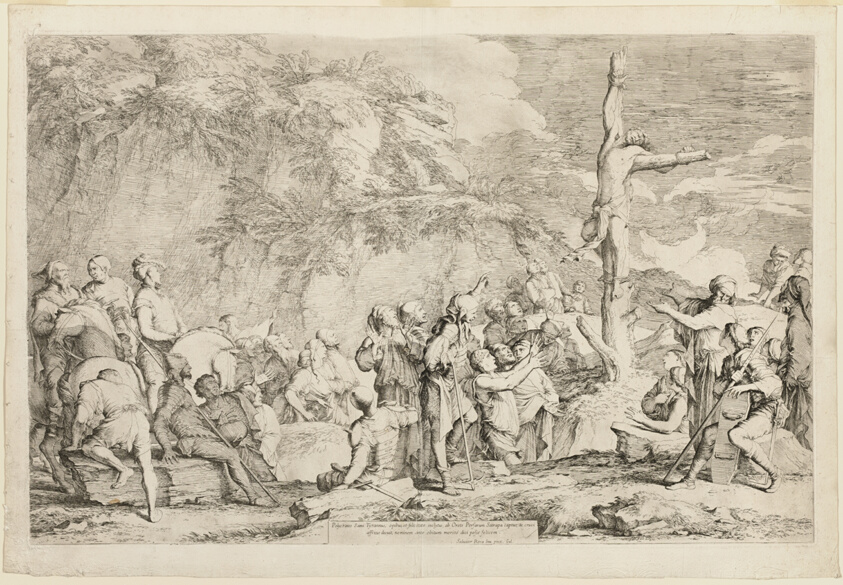
The Crucifixion of Polycrates
Salvator Rosa (Italian, 1615-1673)
c. 1662
- Medium
- Etching, with drypoint, in black on ivory laid paper
- Classification
- Dimensions
- Plate: 47 × 72.8 cm (18 9/16 × 28 11/16 in.); Sheet: 52.6 × 77 cm (20 3/4 × 30 3/8 in.)
- Culture
- Italy
- Museum
- Art Institute of Chicago, Prints and Drawings
- Credit line
- John H. Wrenn Memorial Endowment
- Rights
- Public domain (CC0), as the museum states it.
- Who can see it
- Teens profiles and older: its subject is for older viewers (war, death, the Passion, drink or the like). How works are placed
View at the Art Institute of Chicago
About this work
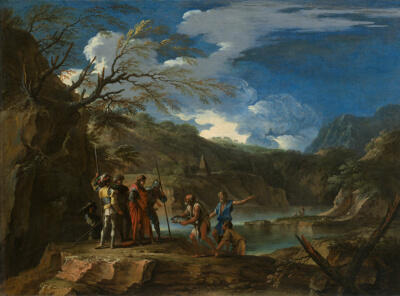
Salvator Rosa was an important printmaker as well as an admired painter. The artist’s oversize etching of the Greek Polycrates’ crucifixion by his Persian enemy (c. 522 b.c.) probably preceded his painting of the same subject. Rosa’s slightly simplified painting appears in reverse, likely because he worked from the print’s preparatory cartoon to create it. The legend beneath the print reads: “Polycrates, tyrant of Samos, famous for his wealth and good fortune, when he was captured by Oretes, Satrap of the Persians, and fastened on a cross, showed that no man can be truly called happy until he is dead.”
Description © Art Institute of Chicago, CC BY 4.0