Window mode follows your eyes with your camera, in this browser only: no picture or position leaves your device.
Takemoto-School Surimono
Nagayama Kien (Japanese, active 19th century)
1847
- Medium
- Color woodblock print; surimono
- Classification
- Dimensions
- 50.8 × 37 cm (20 × 14 5/8 in.)
- Culture
- Japan
- Museum
- Art Institute of Chicago, Arts of Asia
- Credit line
- Charles H. Mitchell Collection unrestricted gift
- Rights
- Public domain (CC0), as the museum states it.
- Who can see it
- Tweens profiles and older: its subjects are known and suit older children. How works are placed
View at the Art Institute of Chicago
About this work
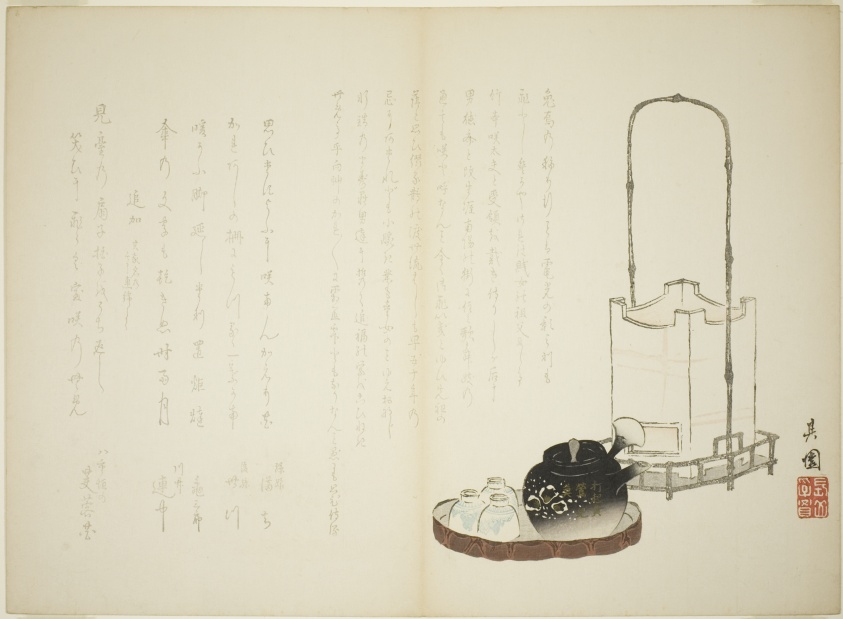
During the late 18th century, Japanese culture was strongly influenced by Chinese traditions, such as the steeped-tea ceremony (sencha) illustrated here, and the demand for Chinese-style rituals increased tremendously. Intellectuals, samurai, well-educated townspeople, and artists came to advocate sencha, partly as a reaction against the conventionalism of chanoyu system. Large-scale production of the objects used in the ceremony, often based on imported Chinese objects, accompanied the growing interest in the sencha. Here Nagayama Kien depicted typical objects used in the sencha ceremony. This is a memorial surimono for the 50-year anniversary of the death of the Takemoto school gidayu chanter Takemoto Sakidayu I (died 1779). Sakidayu worked as a chanter in Osaka and Kyoto Kabuki theaters. This print was commissioned by Machi and Yotsu Sakidayu and their family to celebrate their grandfather.
Description © Art Institute of Chicago, CC BY 4.0