Window mode follows your eyes with your camera, in this browser only: no picture or position leaves your device.
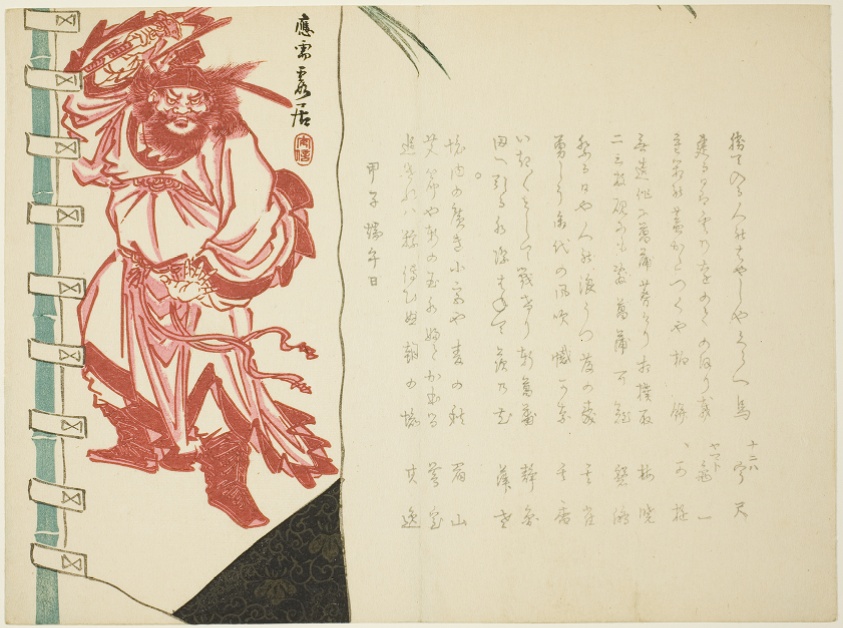
Shoki Banner
Matsukawa Hanzan (Japanese, c. 1820-1882)
1864
- Medium
- Color woodblock print; surimono
- Classification
- Dimensions
- 24.8 × 18.2 cm (9 13/16 × 7 3/16 in.)
- Culture
- Japan
- Museum
- Art Institute of Chicago, Arts of Asia
- Credit line
- Charles H. Mitchell Collection unrestricted gift
- Rights
- Public domain (CC0), as the museum states it.
- Who can see it
- Teens profiles and older: its museum says too little about what it shows to place it for younger viewers. How works are placed
View at the Art Institute of Chicago
About this work
In this print, a portrait of the demon slayer Shoki appears on a fluttering banner. Raising a sword in his right hand, he wards off attackers with his outstretched left hand. Banners featuring Shoki traditionally appeared at the Boys’ Day festival, partly to celebrate the boys in a family and partly to guard against disease. Both Shoki and the color red were believed to be effective barriers against common and often deadly diseases like smallpox.
In addition to illustrating many books, Hanzan also created surimono prints for poetry groups active in the Osaka and Kyoto areas. He signed this work with the term oju, indicating that it was made in return for a friendly request, perhaps from Kiitsu, the leader of this poetry gathering.
Description © Art Institute of Chicago, CC BY 4.0