Window mode follows your eyes with your camera, in this browser only: no picture or position leaves your device.
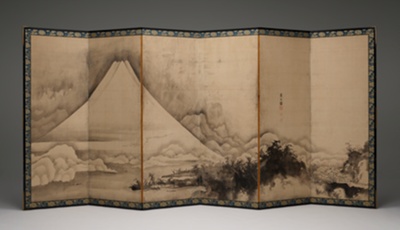
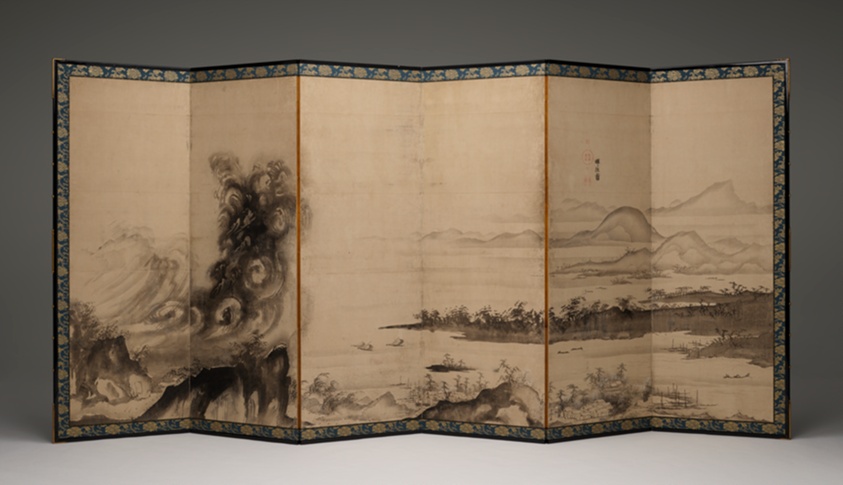
Mount Fuji and the Miho Pine Forest
Soga Shohaku (Japanese, 1730-1781)
c. 1761-1762
- Medium
- Pair of six panel screens; ink and light colors on paper
- Classification
- Painting
- Dimensions
- 157.5 × 362 cm (62 1/16 × 142 9/16 in.)
- Culture
- Japan
- Museum
- Art Institute of Chicago, Arts of Asia
- Credit line
- Through prior gift of Mr. and Mrs. Samuel M. Nickerson
- Rights
- Public domain (CC0), as the museum states it.
- Who can see it
- Little Ones profiles and older: it shows gentle subjects for the very young. How works are placed
View at the Art Institute of Chicago
About this work
Japanese painter Soga Shōhaku created this scene over two folding screens, pairing a rising dragon with a forested landscape and the iconic Mount Fuji. A rare expression of this auspicious subject, this is the earliest and largest known version of the theme of Mount Fuji and the dragon together in one composition. Mount Fuji and its surrounding landscape is a quintessential symbol of Japan. The inclusion of a dragon is particularly meaningful, as homonyms in Japanese for “Fuji” and “dragon” combine to create the meaning of “removing all unhappiness.” Shōhaku was not associated with any established school of painting and little is known about his biography. The artist earned his reputation for his technical skills with monochrome ink painting and his irreverence for traditional norms—both qualities on display in this work. Here,
Shōhaku adeptly rendered lush trees, craggy rocks, and a snow-covered mountain, as well as intangible atmospheric details such as wind, rain, and clouds. Mount Fuji itself is painted in the negative with the white of the paper expressing the snow-covered mountain whose contours are created with layers of ink wash surrounding it. Reading the composition…
Description © Art Institute of Chicago, CC BY 4.0