Window mode follows your eyes with your camera, in this browser only: no picture or position leaves your device.
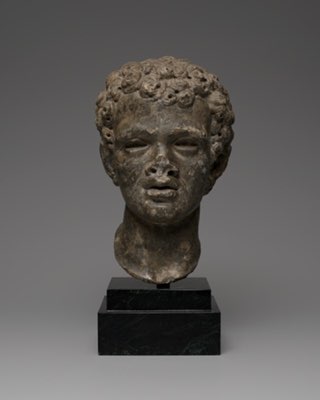
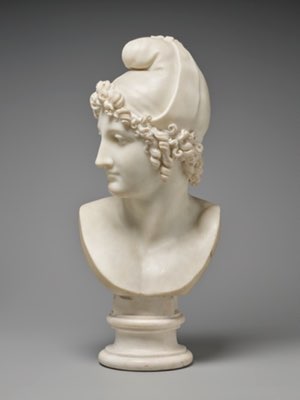
Portrait Bust of Antinous as Osiris
130-138, with 21st–century English restorations
- Medium
- Marble
- Classification
- Sculpture
- Dimensions
- Including socle: 94 × 68.6 × 47 cm (37 1/16 × 27 1/16 × 18 9/16 in.); 94 × 68.6 × 47 cm (37 × 27 × 18 1/2 in.)
- Museum
- Art Institute of Chicago, Arts of Greece, Rome, and Byzantium
- Credit line
- Anonymous loan
- Rights
- Public domain (CC0), as the museum states it.
- Who can see it
- Teens profiles and older: its subject is for older viewers (war, death, the Passion, drink or the like). How works are placed
View at the Art Institute of Chicago
About this work
Antinous (about 111–130), the young lover of Emperor Hadrian (reigned 117–38), drowned in the Nile River in the year 130 while they were on an imperial tour of Egypt. Devastated by the untimely death, Hadrian founded a city in his honor, Antinoupolis, located on the east bank of the Nile, and pronounced him a god. Worship of Antinous spread, and over time portraits of him were produced throughout the Roman Empire.
In this depiction, Antinous wears the traditional headdress of an Egyptian pharaoh known as a nemes. This regalia identifies him with Osiris, the Egyptian god of the underworld, who drowned in the Nile and was reborn from its waters.
Description © Art Institute of Chicago, CC BY 4.0