Window mode follows your eyes with your camera, in this browser only: no picture or position leaves your device.
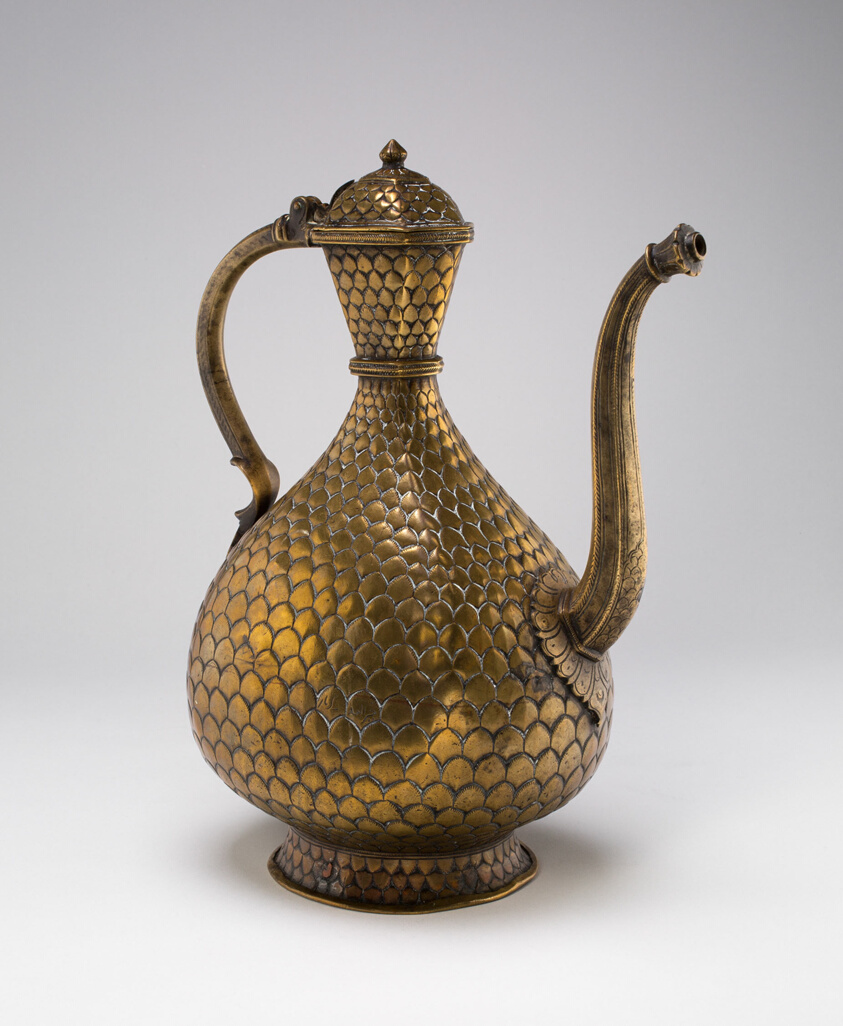
Ewer with Engraved Fish Scale Pattern, Inscribed in Persian with the name "Khairullah"
India (Deccan)
Early 18th century
- Medium
- Brass repoussé
- Classification
- Decorative Arts
- Dimensions
- H.: 32 cm (12 5/8 in.)
- Culture
- India
- Museum
- Art Institute of Chicago, Arts of Asia
- Credit line
- Major Acquisitions Centennial Fund
- Rights
- Public domain (CC0), as the museum states it.
- Who can see it
- Little Ones profiles and older: it shows gentle subjects for the very young. How works are placed
View at the Art Institute of Chicago
About this work
The Sultans of the Deccan (r. 1347-1636) in South India combined the Persian aesthetic with the Indic to forge a new Indo-Islamic idiom. In this ewer, we see the confrontation of the Indic preference for a sensuous fullness of volume, weight, balance, and a naturalistic silhouette (representing shapes such as gourds, mangoes, fruits, and birds) with the Islamic preference for the abstract, ethereal, and attenuated silhouette from Iran. The Indic aspect of this Indo-Islamic vessel is evident in the voluptuous, bottom-heavy, pear-shaped belly on raised on a pedestal foot, rising to a tall slender neck with a disk or “bulge” in the center, to a dome shaped top. The curvaceous handle echoes the rounded belly, while the spout, with a chased band of chevron, rises in a gentle S-curve to a lotiform mouth. A fully opened lotus surrounds the base of the spout. It is chased in a repoussé fish-scale motif, a naturalistic trait which at first blush would signify its Indian origin, but which may be a motif imported from Turkey, as seen in Iznik ceramics of the late 16th century. It is inscribed with the Persian name “Khairullah,” probably the owner’s name. Inscriptions indicate that the…
Description © Art Institute of Chicago, CC BY 4.0