Window mode follows your eyes with your camera, in this browser only: no picture or position leaves your device.
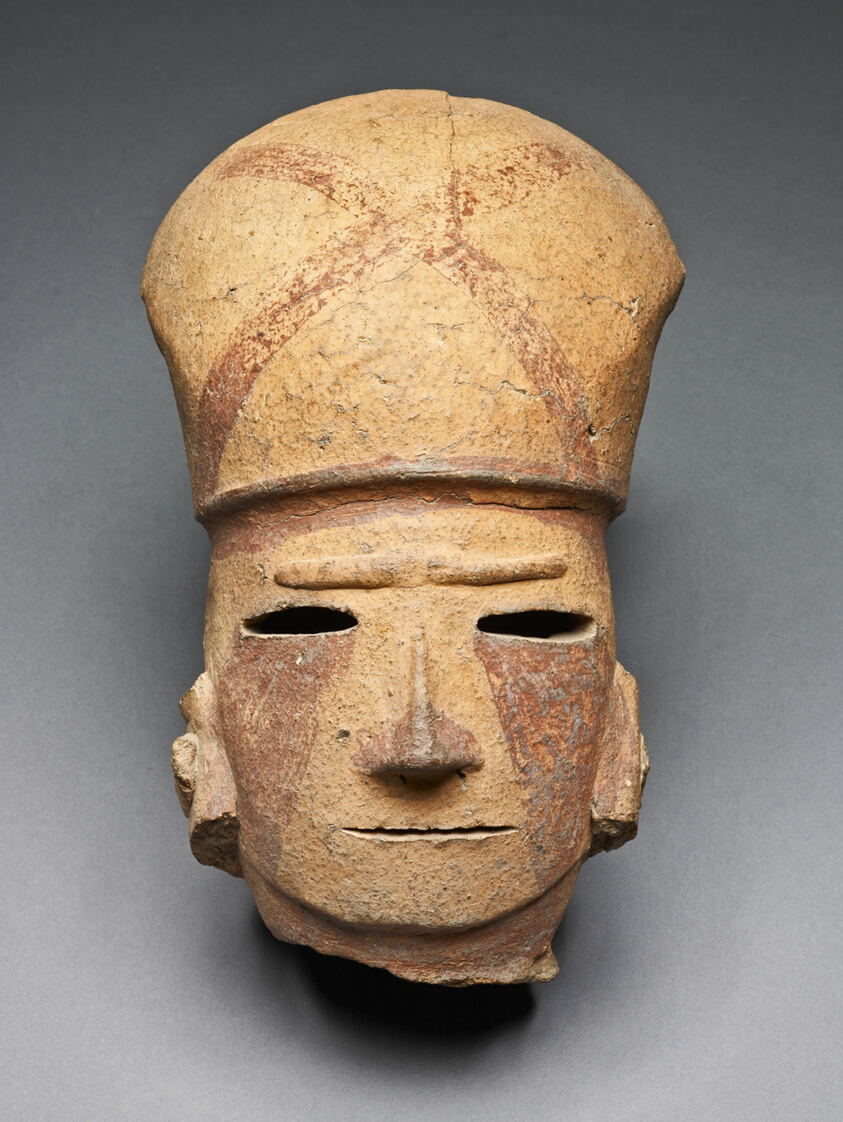
Head of a Warrior
Japan (Artist Unknown)
6th century Kofun period (mid 3rd–6th century A.D.)
- Medium
- Earthenware
- Classification
- Sculpture
- Dimensions
- 25.5 × 15.5 × 12.2 cm (10 × 6 1/8 × 4 3/4 in.)
- Culture
- Japan
- Museum
- Art Institute of Chicago, Arts of Asia
- Credit line
- Purchased with Funds Provided by the Weston Foundation; Alyce and Edwin DeCosta and the Walter E. Heller Foundation Fund; Robert Allerton Trust
- Rights
- Public domain (CC0), as the museum states it.
- Who can see it
- Teens profiles and older: its subject is for older viewers (war, death, the Passion, drink or the like). How works are placed
View at the Art Institute of Chicago
About this work
This head of a warrior from an earthenware tomb figurine (haniwa) is from the late Kofun (literally “old burial mound”) period, which is typified by a complex hierarchical society with advanced burial rituals. Several burial mounds or tumuli for chieftains and emperors still exist today, particularly around the Nara area, and it is from such locations that haniwa figurines have been excavated. In the early Kofun period, haniwa were tubular in form so that they could be easily filled with earth and buried. In the fifth century, haniwa were made in a multitude of representational forms, including male and female figures, animals, and houses.
Although there are losses, most notably above the ears and at the back of the head, this sculpture has no repairs or restoration. The calm expression and symmetrical facial features make it one of the most dignified extant haniwa heads. It was once in the collection of the famed potter Hamada Shôji.
Description © Art Institute of Chicago, CC BY 4.0