Window mode follows your eyes with your camera, in this browser only: no picture or position leaves your device.
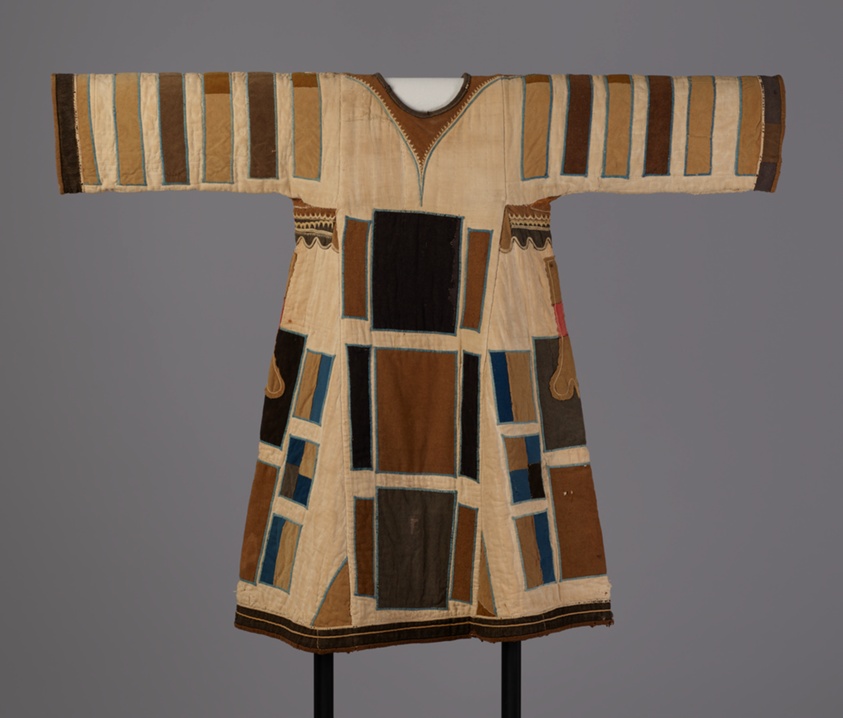
Tunic (Jibbeh)
1885/99
- Medium
- Layers of cotton, plain weave; pieced and quilted; appliquéd with wool and wool and cotton plain weaves and wool twill weaves; embroidered with cotton in chain, cross, and a derivative of herringbone stitches; applied plied yarn edging;…
- Classification
- Costume and Accessories
- Dimensions
- 93.7 × 116.8 cm (36 7/8 × 46 in.)
- Culture
- Sudan
- Museum
- Art Institute of Chicago, Textiles
- Credit line
- African and Amerindian Curator's Discretionary, Holly and David Ross, Arnold H. Crane, African and Amerindian Art Purchase, and O. Renard Goltra funds
- Rights
- Public domain (CC0), as the museum states it.
- Who can see it
- Teens profiles and older: its subject is for older viewers (war, death, the Passion, drink or the like). How works are placed
View at the Art Institute of Chicago
About this work
Sudanese soldiers wore these tailored tunics to mark their role in the Mahdist state’s fight for independence from British and Egyptian rule in the late 19th century. Appliqué elements, such as the sewn shapes seen here, have long held religious significance in Sudan when they appear as talismanic pockets. They also reference the woolen patches haphazardly applied to homemade garments that Sufi followers wore to declare their contempt for worldly goods. The orderly design of this tunic symbolizes a unified army. The clean lines and uniform arrangement of patches symbolize the Mahdi’s efforts to centralize and organize military loyalties, while still honoring soldiers’ long-held Sufi beliefs.
Description © Art Institute of Chicago, CC BY 4.0