Window mode follows your eyes with your camera, in this browser only: no picture or position leaves your device.
Mourning Sampler
Smith Family (Boston, Massachusetts, United States)
About 1815
- Medium
- Linen, plain weave; embroidered with silk floss in tent, cross, long, stem, whip, and couching stitches
- Classification
- Textile
- Dimensions
- 50.2 × 53.7 cm (19 3/4 × 21 1/8 in.)
- Culture
- Massachusetts
- Museum
- Art Institute of Chicago, Textiles
- Credit line
- Barbara Notz Hines Memorial Fund; Elizabeth M. Schultz Endowment
- Rights
- Public domain (CC0), as the museum states it.
- Who can see it
- Teens profiles and older: its subject is for older viewers (war, death, the Passion, drink or the like). How works are placed
View at the Art Institute of Chicago
About this work
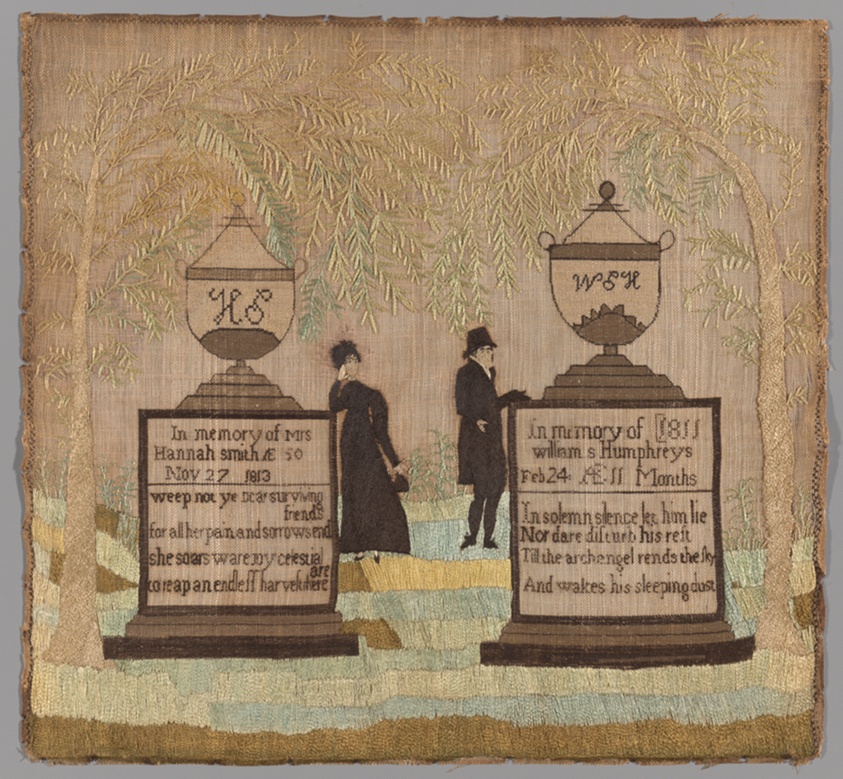
Mourning samplers—embroidered remembrances of deceased family members—were often part of the curriculum for American girls at private academies in the early 19th century. The silk thread used in such works was expensive and embroidery of this style required advanced needlework skills. These samplers showcased a schoolgirl’s accomplishments and attested to her family’s ability to provide her with an education.
The two figures in this sampler mourn the deaths of Hannah (Phipps) Smith (1763–1813) and her grandson William Smith Humphreys (1810–1811), the son of Catherine Smith Humphreys (1786–?) and George Humphreys, who married in Boston in 1804. It was made by an unidentified member of either the Smith or Humphreys families. The death of George Washington in 1799 gave rise to a number of mourning or memorial embroideries in honor of the first president. This led to the popularity of embroidered mourning or memorial works dedicated to departed family members, and they became a fashionable way to express grief and remembrance.
Description © Art Institute of Chicago, CC BY 4.0












