Window mode follows your eyes with your camera, in this browser only: no picture or position leaves your device.
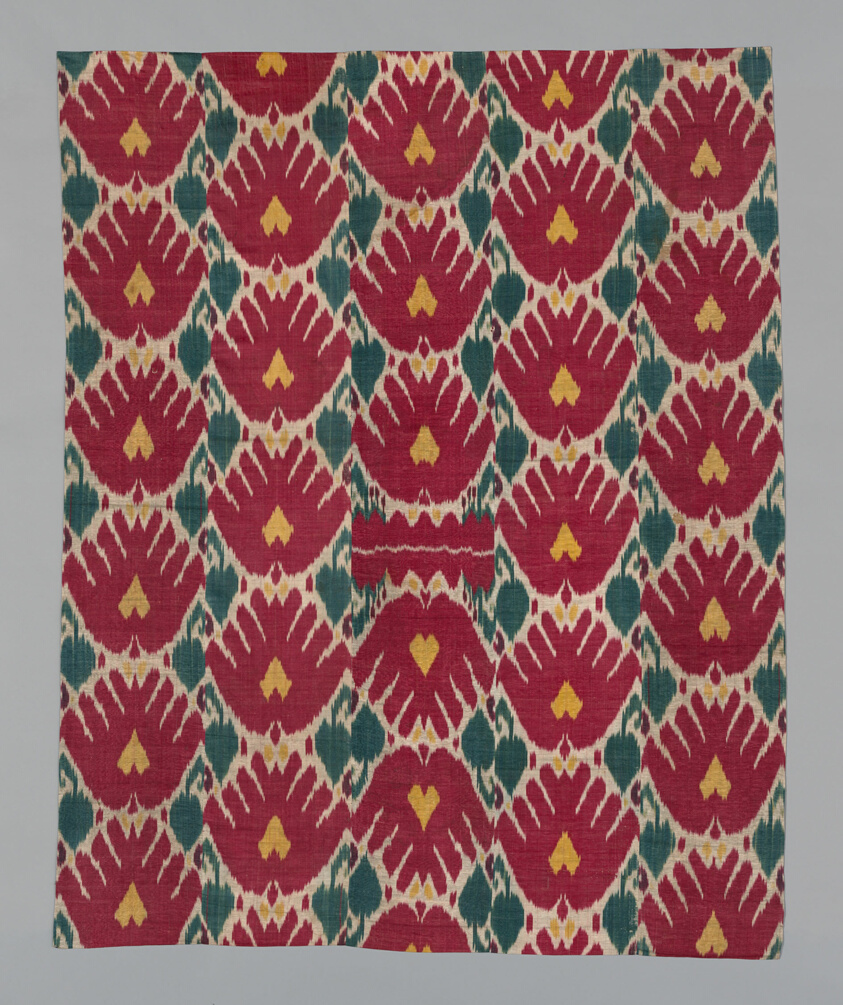
Wall Hanging Composed of Five Panels
Uzbekistan, Samarkand or Bukhara
1850/75
- Medium
- Silk, warp-faced plain weave; warp-dyed (ikat)
- Classification
- Coverings and Hangings
- Dimensions
- 166 × 132.1 cm (65 × 52 in.)
- Culture
- Uzbekistan
- Museum
- Art Institute of Chicago, Textiles
- Credit line
- Gift of Guido Goldman
- Rights
- Public domain (CC0), as the museum states it.
- Who can see it
- Tweens profiles and older: its subjects are known and suit older children. How works are placed
View at the Art Institute of Chicago
About this work
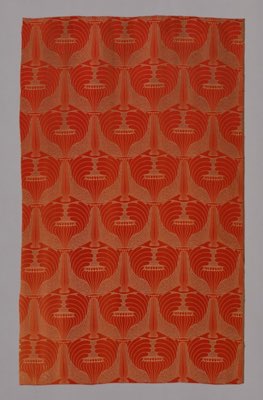
The ikat dyeing technique was brought to a high level of accomplishment in the 19th century in Central Asia, particularly in the area around the Fergana Valley, in modern-day Uzbekistan. The time-consuming process involves sequentially dyeing bundles of warps and wefts in multiple colors, each time with particular areas tightly wrapped to resist dye penetration, all before they are woven. Warps are then stretched on the loom and wefts are passed so as to create the intended pattern. While the patterns on these objects can be difficult to decipher, many appear to derive from floral motifs, talismanic forms, and Persian patterns. the chief design element here could have been based on a serrated leaf, a flower, or even a peacock.
Description © Art Institute of Chicago, CC BY 4.0