Window mode follows your eyes with your camera, in this browser only: no picture or position leaves your device.
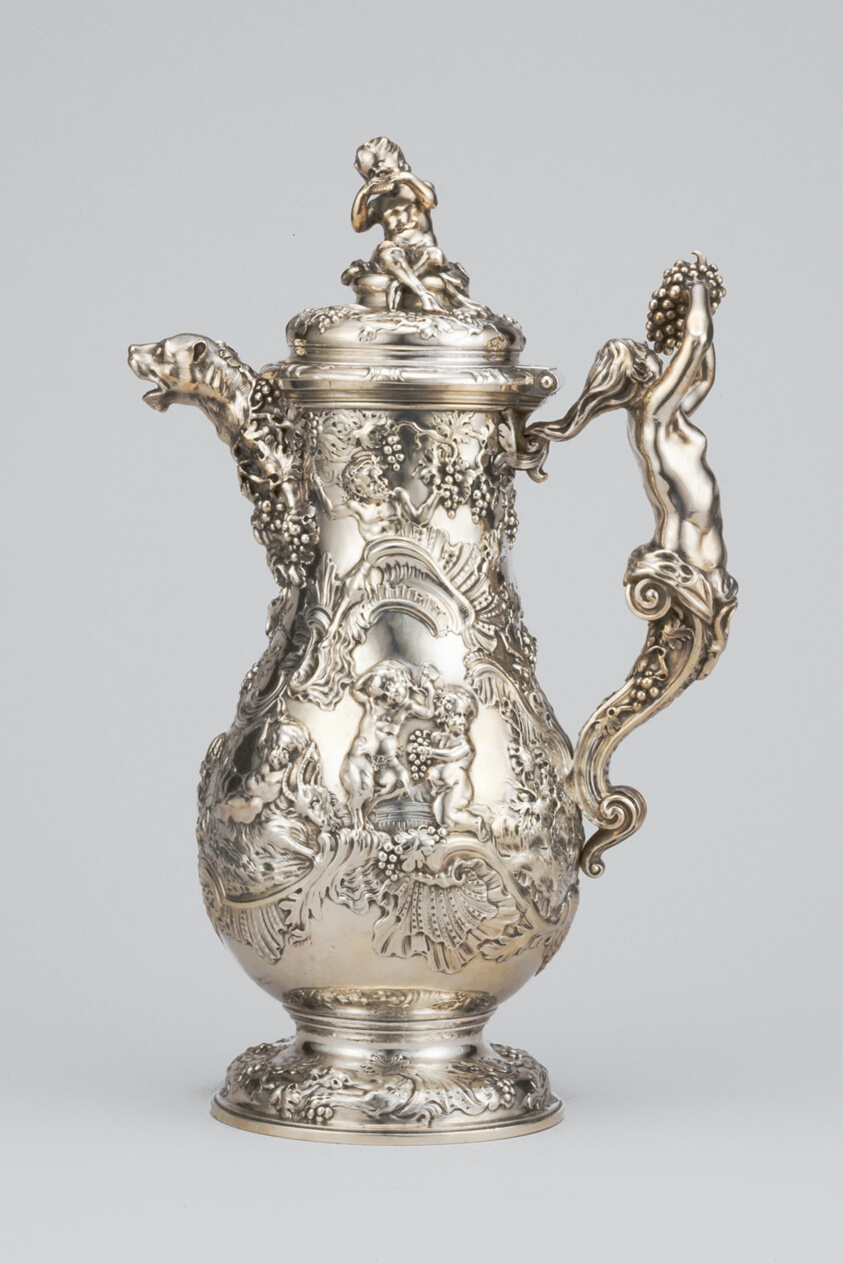
Wine Ewer
Charles Frederick Kandler (London)
1739–40
- Medium
- Silver
- Classification
- Metalwork
- Dimensions
- 34 × 21.3 × 13.9 cm (13 3/8 × 8 3/8 × 5 7/16 in.)
- Culture
- London
- Museum
- Art Institute of Chicago, Applied Arts of Europe
- Credit line
- Gift of the Antiquarian Society
- Rights
- Public domain (CC0), as the museum states it.
- Who can see it
- Teens profiles and older: its subject is for older viewers (war, death, the Passion, drink or the like). How works are placed
View at the Art Institute of Chicago
About this work
This jug was originally one of a pair made by the German emigré silversmith Charles Frederick Kandler. It bears the mark FK, which was registered in 1735 to Kandler, who presumably took over a family workshop from a relative. It is possible that he was related to Johann Joachim Kandler, chief modeler at the Meissen Porcelain Manufactory from 1733 to 1775, who designed the Art Institute’s lively and ornamental monkey band sculpture. Whatever the family relationship might have been, the Kandler style in silver, characterized by a profusion of cast and hammered three-dimensional ornament, emerged in the late 1720s—as early, if not even earlier, than the sculptural style at Meissen.
The exuberant decoration of the piece is perfectly balanced with its function. Since it is a wine ewer, it is covered with figures associated with Dionysus (also called Bacchus), the Classical god of wine: a seated infant Pan playing his pipes forms the finial; the spout is in the form of a panther’s head, its shoulders encircled by grapevines; and the handle is a maiden holding a cluster of grapes in her upstretched arms. On the belly of the ewer, cartouches formed of scrolls, shells, and undulating…
Description © Art Institute of Chicago, CC BY 4.0