Window mode follows your eyes with your camera, in this browser only: no picture or position leaves your device.
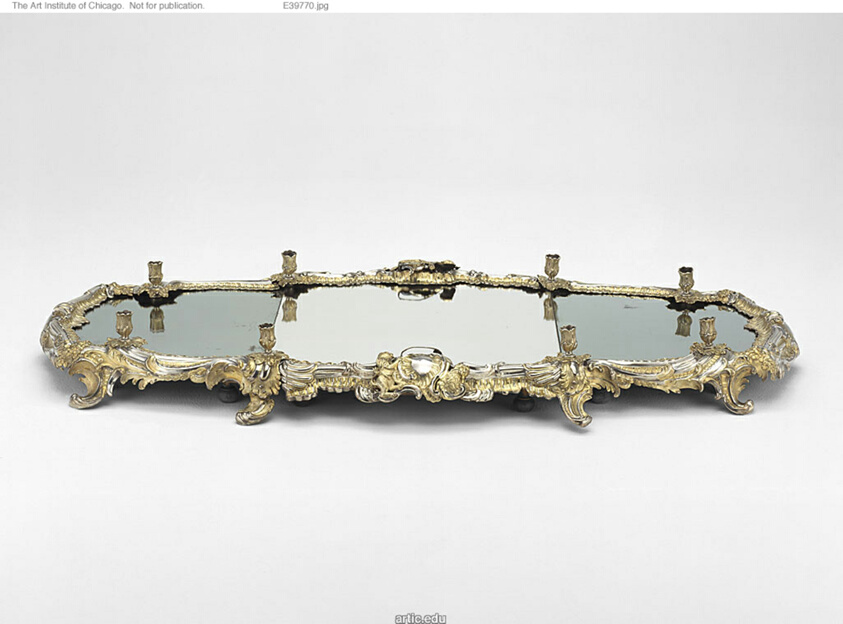
Table Centerpiece
c. 1750
- Medium
- Silver, silver gilt, mirror glass, and wood
- Classification
- Metalwork
- Dimensions
- 15.6 × 137.8 × 66.7 cm (6 1/8 × 54 1/4 × 26 1/4 in.)
- Culture
- Turin
- Museum
- Art Institute of Chicago, Applied Arts of Europe
- Credit line
- Gift of the Antiquarian Society
- Rights
- Public domain (CC0), as the museum states it.
- Who can see it
- Teens profiles and older: its museum says too little about what it shows to place it for younger viewers. How works are placed
View at the Art Institute of Chicago
About this work
This silver and glass plateau is a rare survival of the festive table decorations that were so popular in the 18th century. It formed the visual climax of a formal dinner’s final course; dessert. Designed in the Rococo style, the centerpiece has a border of asymmetrical scrolls, waves, and flower clusters, further enlivened by alternating reflective and matte surfaces. Decorative arrangements of sugar-paste or porcelain figures were placed on the mirrored surfaces of the plateau to entertain dinner guests, and it would have been surrounded by candles that would have shed light on the elaborate arrangement. This plateau was made in Turin, Italy, but the practice of decorating aristocratic tables with miniature gardens, and even scenes from contemporary plays and operas, extended throughout Europe.
The centerpiece is composed of three sections, so users had the option of shortening it for more intimate gatherings by removing the center section. Affixed to the sides are two symmetrically shaped cartouches, or ornamental panels, each surmounted by a crown and supported by a pair of lions. Since no coats of arms appear to have been engraved within the cartouches, it isn’t possible to…
Description © Art Institute of Chicago, CC BY 4.0