Window mode follows your eyes with your camera, in this browser only: no picture or position leaves your device.
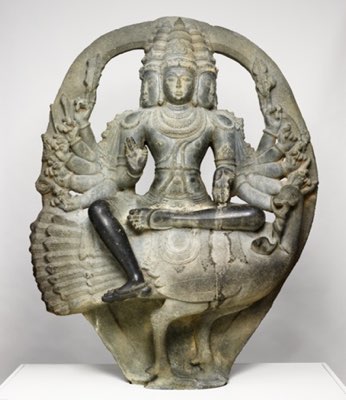
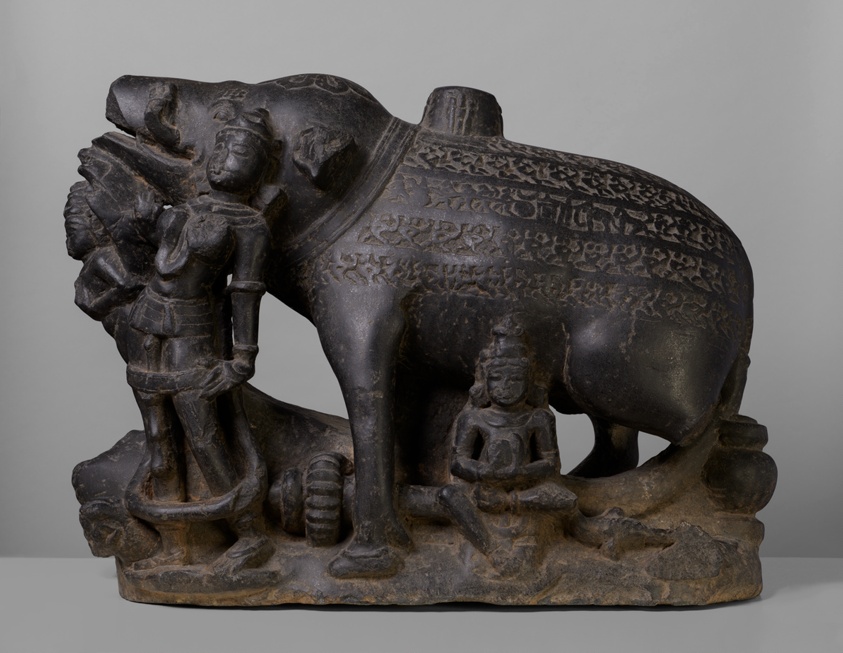
Boar Incarnation of God Vishnu (Varaha)
India (Madhya Pradesh)
c. 10th century
- Medium
- Phyllite
- Classification
- Sculpture
- Dimensions
- 56 × 79.5 × 29.7 cm (22 1/16 × 31 5/16 × 11 11/16 in.)
- Culture
- Madhya Pradesh
- Museum
- Art Institute of Chicago, Arts of Asia
- Credit line
- James W. and Marilynn Alsdorf Collection. Gift of Marilynn Alsdorf
- Rights
- Public domain (CC0), as the museum states it.
- Who can see it
- Tweens profiles and older: its subjects are known and suit older children. How works are placed
View at the Art Institute of Chicago
About this work
When cosmic order is imperiled, Vishnu descends to earth in different avataras (incarnations) to restore it. Varaha, Vishnu’s boar incarnation, is the third of ten such avataras. After the demon Hiranyaksha hides the earth in the primeval ocean, Varaha bores beneath the waters and rescues her, emerging triumphantly with the earth goddess Bhudevi on his tusk. Varaha’s porcine body is covered with rows of sages, animals, and other beings indebted to his beneficence. Vishnu’s signature attributes—the chakra (discus), shankha (conch), and gada (mace)—appear by the boar’s feet. Boar images of Varaha made across central India were often housed in independent shrines facing the main entrance of temples dedicated to Vishnu.
Description © Art Institute of Chicago, CC BY 4.0