Window mode follows your eyes with your camera, in this browser only: no picture or position leaves your device.
Abundantia from The Four Continents and Related Allegories
Lodewijk van Schoor (Woven at the workshop of Albert Auwercx (1629–1709); Brussels)
c. 1680/1700
- Medium
- Wool and silk, slit and double interlocking tapestry weave Warp: Count: 7 warps per cm; wool: S-ply of three Z-spun elements; diameters: 0.7–0.9 mm Weft: Count: varies from 28 to 44 wefts per cm; wool: single S-spun elements; S-ply of two…
- Classification
- Textile
- Dimensions
- 371.2 × 382.5 cm (146 1/8 × 150 1/2 in.)
- Culture
- Brussels
- Museum
- Art Institute of Chicago, Textiles
- Credit line
- Gift of Benjamin E. Bensinger, III
- Rights
- Public domain (CC0), as the museum states it.
- Who can see it
- Teens profiles and older: its museum says too little about what it shows to place it for younger viewers. How works are placed
View at the Art Institute of Chicago
About this work
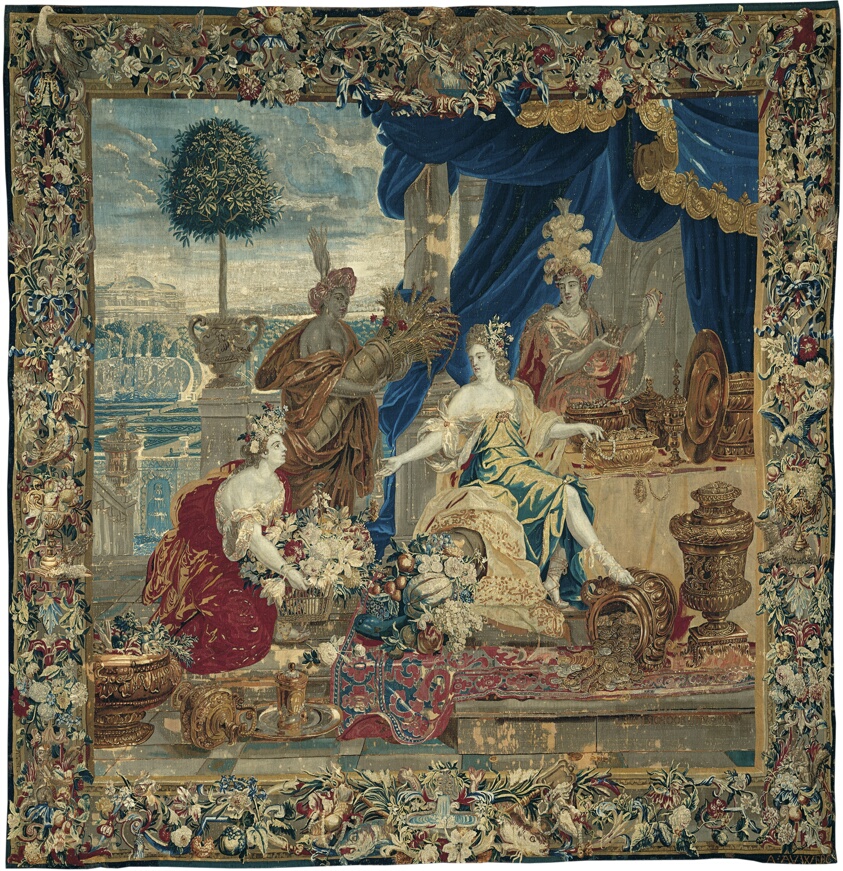
In this tapestry, part of a Four Continents and Related Allegories set, Abundantia, a female personification of abundance, sits on a horn of plenty overflowing with fruit, surrounded by three female attendants, each representing a continent. The kneeling woman crowned with a circlet of blossoms, offering a basket of flowers and fruit, personifies Asia. The dark-skinned woman bearing a horn of plenty full of sheaves of grain represents Africa. The third attendant, who wears a feathered headdress and displays gold, silver, and pearls, can be identified as America. The attributes of all four figures are based on Cesare Ripa’s Iconologia (1593), and their depiction exemplifies the early style of their designer, Lodewijck van Schoor: they have elongated bodies, small heads, long noses, and broad arms and legs, and though they gesture dramatically, their poses are formulae repeated throughout the set.
Description © Art Institute of Chicago, CC BY 4.0












