Window mode follows your eyes with your camera, in this browser only: no picture or position leaves your device.
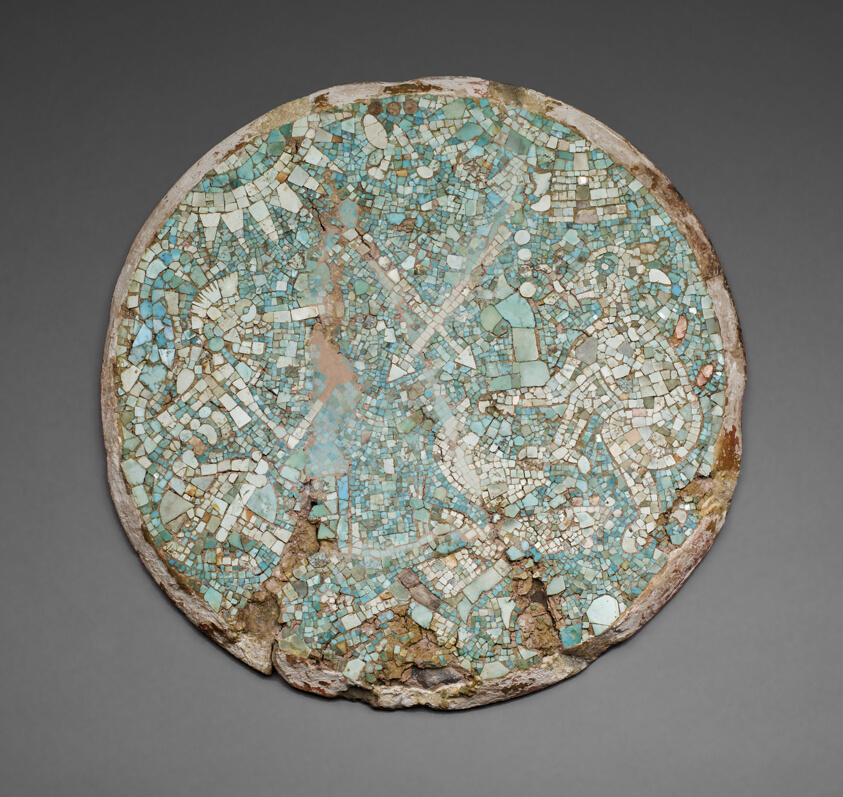
Mosaic Disk with a Mythological and Historical Scene
Mixtec (Northern Oaxaca, Mexico)
1400–1500
- Medium
- Turquoise, earthenware, stucco, spondylus shell, mother of pearl, and iron pyrite, with pigment
- Classification
- Religious/Ritual Object
- Dimensions
- Diam.: 30.5 cm (12 in.)
- Culture
- Oaxaca state
- Museum
- Art Institute of Chicago, Arts of the Americas
- Credit line
- Through prior gift of Louise A. and Ruth G. Allen, and Mrs. Daniel Catton Rich
- Rights
- Public domain (CC0), as the museum states it.
- Who can see it
- Teens profiles and older: its subject is for older viewers (war, death, the Passion, drink or the like). How works are placed
View at the Art Institute of Chicago
About this work
Turquoise and shell mosaics were a specialty of the Mixtecs of northern Oaxaca, whose artists worked in the imperial Aztec (Mexica) capital, Tenochtitlan, after the mid-15th century. This disk commemorates historical events using calendrical and mythological imagery. In Mixtec culture, as elsewhere in ancient Mesoamerica, the history of the world was conceived in terms of cosmic cycles of creation, destruction, and re-creation. Each cycle, known as a “sun,” lasted many centuries. On a smaller scale within each cycle, time was organized into repeating 52-year periods whose end and renewal were marked by equinox sunsets and sunrises in rituals of transition.
On this disk, the sign for “year” and the date “3 Flint- Knife” (A.D. 1456) are associated with the image of the sun on the left; the date “4 House” (A.D. 1457) is linked by footsteps to the sun on the right. These dates mark the end of one 52-year cycle and the beginning of a new one. In the center, crossed darts symbolize a military alliance. Alliance members are represented by the skeletal figure at the left and the animal figure at the right. Below, a prone human form (damaged) signifies a sacrifice to confirm the…
Description © Art Institute of Chicago, CC BY 4.0