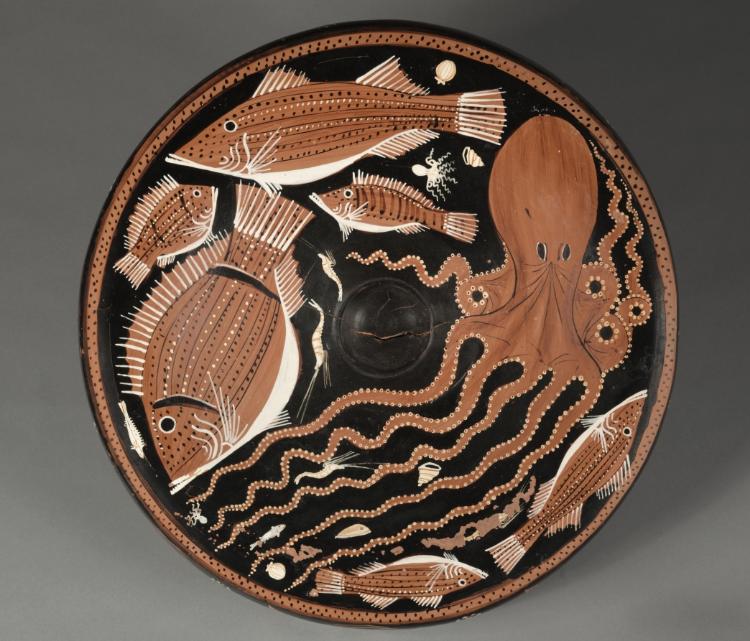
Red-Figure Fish Plate: Octopi, Mullet, Bream, Shellfish
attributed to Asteas/Python Workshop (South Italian, Paestan, active c. 360–320 BCE)
c. 340–330 BCE
- Medium
- ceramic
- Classification
- Ceramic
- Dimensions
- Diameter: 38.3 cm (15 1/16 in.); Overall: 7.9 cm (3 1/8 in.); Diameter of foot: 16 cm (6 5/16 in.)
- Culture
- South Italian, Paestan
- Museum
- Cleveland Museum of Art, Greek and Roman Art
- Credit line
- Leonard C. Hanna Jr. Fund
- Rights
- Public domain (CC0), as the museum states it.
- Who can see it
- Tweens profiles and older: its subjects are known and suit older children. How works are placed
View at the Cleveland Museum of Art
About this work
Although first developed in Athens, red-figure fish plates became especially popular in South Italy and Sicily in the 300s BC. All feature a short foot and a small central depression, but those produced in the workshop of Asteas and Python, like this one, are the largest and most ornate. Archaeologists have closely studied the fish and other sea creatures represented, identifying many of them with species still found (and eaten) in the Mediterranean; included here are octopi, mullet, bream, and various shellfish.