Window mode follows your eyes with your camera, in this browser only: no picture or position leaves your device.
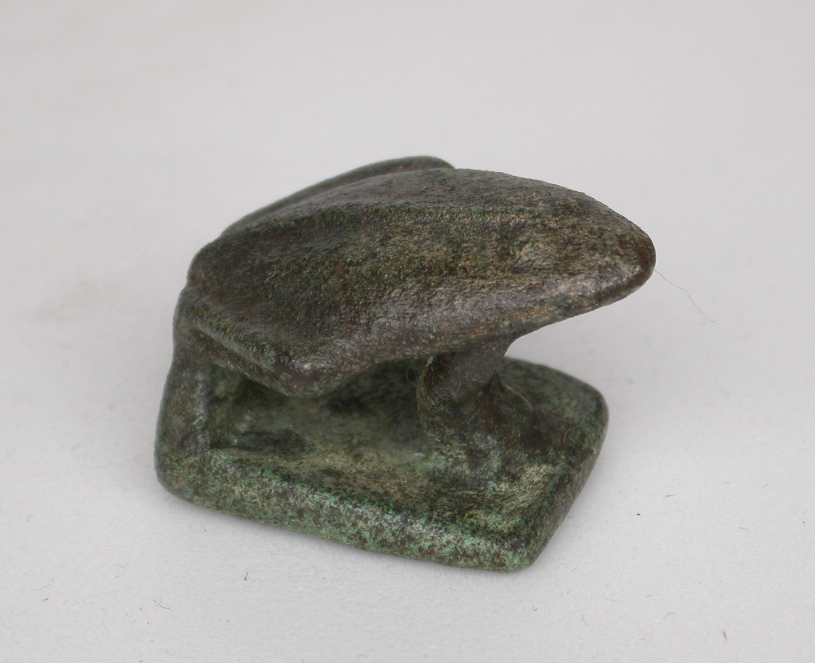
Weight in the Form of a Frog
New Kingdom, about 1550-1069 BCE
- Medium
- Copper alloy
- Classification
- Costume and Accessories
- Dimensions
- 2.2 × 2.3 × 2.6 cm (7/8 × 15/16 × 1 1/16 in.)
- Culture
- Egypt
- Museum
- Art Institute of Chicago, Arts of Africa
- Credit line
- Gift of Henry H. Getty and Charles L. Hutchinson
- Rights
- Public domain (CC0), as the museum states it.
- Who can see it
- Tweens profiles and older: its subjects are known and suit older children. How works are placed
View at the Art Institute of Chicago
About this work
Ancient Egyptians used weights, like this small frog, to help calculate the value of goods. One Ancient Egyptian unit of measurement was the qedet, equivalent to about nine grams. While this piece is small, it weighs 36.1 grams, or about 4 qedets. Since some animals were associated with favorable characteristics like strength and affluence, they became a popular form for weights during the New Kingdom. The Ancient Egyptians linked frogs to fertility and rebirth, likely because of the animal’s prolific reproduction. These ties to abundance may have made frogs a suitable form for objects used to determine value.
Description © Art Institute of Chicago, CC BY 4.0