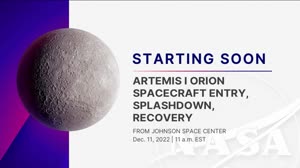
Artemis I Entry Splashdown Recovery Coverage
NASA Johnson Space Center
ScienceSpace
Clips are not offered for this film: NASA's media guidelines set the terms of its reuse themselves, not as a public licence.
Parts
About
From launch to splashdown, NASA’s Orion spacecraft completed its first deep-space mission with a splashdown in the Pacific Ocean, west of Baja California, at 9:40 a.m. PST (12:40 p.m. EST) Sunday. The record-breaking Artemis mission traveled more than 1.4 million miles on a path around the Moon and returned safely to Earth. Splashdown was the final milestone of the Artemis I mission, which began with a successful liftoff of NASA’s Space Launch System (SLS) rocket Nov. 16, from Launch Pad 39B at NASA’s Kennedy Space Center in Florida. Over the course of 25.5 days, NASA tested Orion in the harsh environment of deep space before flying astronauts on Artemis II. During the mission, Orion performed two lunar flybys, coming within 80 miles of the lunar surface. At its farthest distance during the mission, Orion traveled nearly 270,000 miles from our home planet, more than 1,000 times farther than where the International Space Station orbits Earth, to intentionally stress systems before flying crew. Prior to entering the Earth’s atmosphere, the crew module separated from its service module, which is the spacecraft’s propulsive powerhouse provided by ESA (European Space Agency). During re-entry, Orion endured temperatures of about 5,000 degrees Fahrenheit, half as hot as the surface of the Sun. Within about 20 minutes, Orion slowed from nearly 25,000 mph to about 20 mph for its parachute-assisted splashdown. During the flight test, Orion stayed in space longer than any spacecraft…
Human-made No record of this work says a model made it. What this means.
More from NASA
 Film
Expedition 64 Air Space Museum and Museum of African American History and Culture
 Film
Watching the Friendly Skies - Eclipse Safety Tutorial
 Commercial
Inside KSC! for Dec. 27, 2021
 Educational
Expedition 70 Astronaut Furukawa Talks with JAXA Space Education Center Students - Nov. 23, 2023
 Film
Expedition 66 NG 16 Cygnus Release
 Film
Women at Glenn - 60 Seconds with Mary Lobo
 Commercial
CCP Boeing OFT ULA Live Launch Broadcast
 Film
SpaceCast Weekly March 1 2019
 Film
Expedition 70 71 Interviews With Flight Engineer Tracy Dyson 240226
 Film
Human Research Obstacle Course B-roll
 Film
SpaceCast Weekly - October 8, 2021
 Film