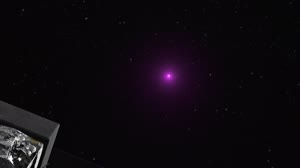
Tracing the History of Starlight with NASA's Fermi Mission
NASA Goddard Space Flight Center
ScienceSpaceHistory
Clips are not offered for this film: NASA's media guidelines set the terms of its reuse themselves, not as a public licence.
Parts
About
Scientists using data from NASA’s Fermi Gamma-ray Space Telescope have measured all the starlight produced over 90 percent of the universe’s history. The analysis, which examines the gamma-ray output of distant galaxies, estimates the formation rate of stars and provides a reference for future missions that will explore the still-murky early days of stellar evolution. One of the main goals of the Fermi mission is to assess the extragalactic background light (EBL), a cosmic fog composed of all the ultraviolet, visible and infrared light stars have created over the universe’s history. Because starlight continues to travel across the cosmos long after its sources have burned out, measuring the EBL allows astronomers to study stellar formation and evolution separately from the stars themselves. The collision between a high-energy gamma ray and infrared light transforms the energy into a pair of particles, an electron and its antimatter counterpart, a positron. The same process occurs when medium-energy gamma rays interact with visible light, and low-energy gamma rays interact with ultraviolet light. Enough of these interactions occur over cosmic distances that the farther back scientists look, the more evident their effects become on gamma-ray sources, enabling a deep probe of the universe’s stellar content. The scientists examined gamma-ray signals from 739 blazars — galaxies with monster black holes at their centers — collected over nine years by Fermi’s Large Area Telescope…
Human-made No record of this work says a model made it. What this means.
More from NASA
 Film
Expedition 64 Air Space Museum and Museum of African American History and Culture
 Film
Watching the Friendly Skies - Eclipse Safety Tutorial
 Commercial
Inside KSC! for Dec. 27, 2021
 Educational
Expedition 70 Astronaut Furukawa Talks with JAXA Space Education Center Students - Nov. 23, 2023
 Film
Expedition 66 NG 16 Cygnus Release
 Film
Women at Glenn - 60 Seconds with Mary Lobo
 Commercial
CCP Boeing OFT ULA Live Launch Broadcast
 Film
SpaceCast Weekly March 1 2019
 Film
Expedition 70 71 Interviews With Flight Engineer Tracy Dyson 240226
 Film
Human Research Obstacle Course B-roll
 Film
SpaceCast Weekly - October 8, 2021
 Film