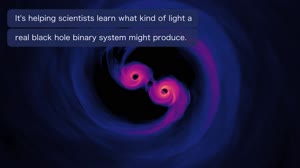
New Simulation Sheds Light on Spiraling Supermassive Black Holes
NASA Goddard Space Flight Center
ScienceSpace
Clips are not offered for this film: NASA's media guidelines set the terms of its reuse themselves, not as a public licence.
Parts
About
A new model is bringing scientists a step closer to understanding the kinds of light signals produced when two supermassive black holes, which are millions to billions of times the mass of the Sun, spiral toward a collision. For the first time, a new computer simulation that fully incorporates the physical effects of Einstein’s general theory of relativity shows that gas in such systems will glow predominantly in ultraviolet and X-ray light. The new simulation shows three orbits of a pair of supermassive black holes only 40 orbits from merging. The models reveal the light emitted at this stage of the process may be dominated by UV light with some high-energy X-rays, similar to what’s seen in any galaxy with a well-fed supermassive black hole. Three regions of light-emitting gas glow as the black holes merge, all connected by streams of hot gas: a large ring encircling the entire system, called the circumbinary disk, and two smaller ones around each black hole, called mini disks. All these objects emit predominantly UV light. When gas flows into a mini disk at a high rate, the disk’s UV light interacts with each black hole’s corona, a region of high-energy subatomic particles above and below the disk. This interaction produces X-rays. When the accretion rate is lower, UV light dims relative to the X-rays. Based on the simulation, which ran on the National Center for Supercomputing Applications’ Blue Waters supercomputer at the University of Illinois at Urbana-Champaign, the…
Human-made No record of this work says a model made it. What this means.
More from NASA
 Film
Expedition 64 Air Space Museum and Museum of African American History and Culture
 Film
Watching the Friendly Skies - Eclipse Safety Tutorial
 Commercial
Inside KSC! for Dec. 27, 2021
 Educational
Expedition 70 Astronaut Furukawa Talks with JAXA Space Education Center Students - Nov. 23, 2023
 Film
Expedition 66 NG 16 Cygnus Release
 Film
Women at Glenn - 60 Seconds with Mary Lobo
 Commercial
CCP Boeing OFT ULA Live Launch Broadcast
 Film
SpaceCast Weekly March 1 2019
 Film
Expedition 70 71 Interviews With Flight Engineer Tracy Dyson 240226
 Film
Human Research Obstacle Course B-roll
 Film
SpaceCast Weekly - October 8, 2021
 Film