
Scientists Create First-Ever 3D Model of a Melting Snowflake
NASA Goddard Space Flight Center
ScienceSpace
Clips are not offered for this film: NASA's media guidelines set the terms of its reuse themselves, not as a public licence.
Parts
About
This visualization is based on the first three-dimensional numerical model of melting snowflakes in the atmosphere, developed by scientist Jussi Leinonen of NASA's Jet Propulsion Laboratory in Pasadena, California. A better understanding of how snow melts can help scientists recognize the signature in radar signals of heavier, wetter snow -- the kind that breaks power lines and tree limbs -- and could be a step toward improving predictions of this hazard. The model reproduces key features of melting snowflakes that have been observed in nature: first, meltwater gathers in any concave regions of the snowflake's surface. These liquid-water regions merge as they grow and eventually form a shell of liquid around an ice core, finally developing into a water drop. The visualization shows a typical snowflake less than half an inch (one centimeter) long. The snowflake is composed of individual ice crystals whose arms became entangled when they collided in the air. The extremities of the arms melt first because they are more exposed to heat from the surrounding air. Water first fills small cavities within the ice crystals, and then these overflow, allowing water to pool into droplets. "I got interested in modeling melting snow because of the way it affects our observations with remote sensing instruments," Leinonen said. A radar "profile" of the atmosphere from top to bottom shows a very bright, prominent layer at the altitude where falling snow and hail melt, much brighter than the…
Human-made No record of this work says a model made it. What this means.
- Archive
- NASA Image and Video Library, in NASA
- Licence or status
- NASA media guidelines, as the NASA Image and Video Library states it.
- Credit
- NASA Goddard Space Flight Center
- Language
- English
- Country
- United States
- Subtitles
- English
- Who can watch
- The archive gives no rating. Invisible Network shows it to Tweens profiles and older, judged from its collection and subjects. How films are placed
More from NASA
 Film
Expedition 65 JAXA PAO Event
 Film
GPM Instrument Animations
 Film
An EPIC View of the 2017 Total Solar Eclipse
 Film
Can You Spot Hubble: Long
 Film
Predicting Malaria Outbreaks with NASA Satellites
 Commercial
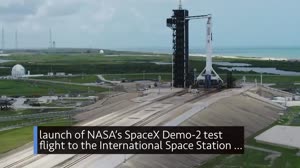
Launching America On a Commercial Spacecraft on This Week @NASA – June 5, 2020
 Film
NASA joins last of five sections for Space Launch System Rocket stage
 Film
Science Launching on SpaceX's 30th Cargo Resupply Mission to the Space Station
 Film
Jessica Meir Speaks with Physiologist Magazine
 Film
Video File: Launch of NASA’s Next Mars Rover Perseverance Approaches
 Film
Expedition 63 HTV 9 Release
 Film