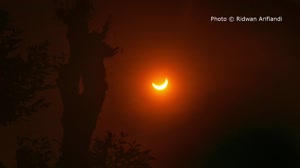
The Moon's Role in a Solar Eclipse
NASA Goddard Space Flight Center
ScienceSpace
Clips are not offered for this film: NASA's media guidelines set the terms of its reuse themselves, not as a public licence.
Parts
About
While the sun is the main focus of a solar eclipse, our moon plays the most crucial role in creating this unique event. This video tutorial explains what happens during a total solar eclipse and a partial eclipse and how often they both occur. The video also explains how a solar eclipse differs from a lunar eclipse, and gives a helpful tip on how to remember the difference. In addition, the video examines how the two parts of the moon’s shadow, the umbra and penumbra, affect how we see an eclipse on the Earth, and illustrates the surprising true shape of the umbra. The video concludes by highlighting how data from NASA’s Lunar Reconnaissance Orbiter has helped us better map a solar eclipse’s path of totality. Visualizations included in this piece showcase the August 21, 2017 total solar eclipse happening in the United States.
Human-made No record of this work says a model made it. What this means.
More from NASA
 Film
Expedition 64 Air Space Museum and Museum of African American History and Culture
 Film
Watching the Friendly Skies - Eclipse Safety Tutorial
 Commercial
Inside KSC! for Dec. 27, 2021
 Educational
Expedition 70 Astronaut Furukawa Talks with JAXA Space Education Center Students - Nov. 23, 2023
 Film
Expedition 66 NG 16 Cygnus Release
 Film
Women at Glenn - 60 Seconds with Mary Lobo
 Commercial
CCP Boeing OFT ULA Live Launch Broadcast
 Film
SpaceCast Weekly March 1 2019
 Film
Expedition 70 71 Interviews With Flight Engineer Tracy Dyson 240226
 Film
Human Research Obstacle Course B-roll
 Film
SpaceCast Weekly - October 8, 2021
 Film