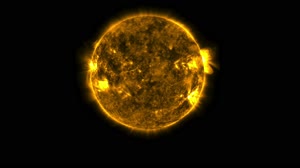
Solar Highlights of 2016/2017: Double Eclipse
NASA Goddard Space Flight Center
ScienceSpace
Clips are not offered for this film: NASA's media guidelines set the terms of its reuse themselves, not as a public licence.
Parts
About
Early in the morning of Sept. 1, 2016, NASA’s Solar Dynamics Observatory, or SDO, caught both the Earth and moon crossing in front of the sun. SDO keeps a constant eye on the sun, but during SDO’s semiannual eclipse seasons, Earth briefly blocks SDO’s line of sight each day – a consequence of SDO’s geosynchronous orbit. On Sept. 1, Earth completely eclipsed the sun from SDO’s perspective just as the moon began its journey across the face of the sun. The end of the Earth eclipse happened just in time for SDO to catch the final stages of the lunar transit. In the SDO data, you can tell Earth and the moon’s shadows apart by their edges: Earth’s is fuzzy, while the moon’s is sharp and distinct. This is because Earth’s atmosphere absorbs some of the sun’s light, creating an ill-defined edge. On the other hand, the moon has no atmosphere, producing a crisp horizon. This particular geometry of Earth, the moon and the sun also resulted in a simultaneous ring of fire, or annular, eclipse visible from southern Africa. Annular eclipses are similar to total solar eclipses, except that they happen when the moon is at a point in its orbit farther from Earth than average – meaning that the moon’s apparent size is smaller, and it can’t block the entire face of the sun. This leaves a narrow ring of the solar surface visible, often called a ring of fire.
Human-made No record of this work says a model made it. What this means.
More from NASA
 Film
Expedition 64 Air Space Museum and Museum of African American History and Culture
 Film
Watching the Friendly Skies - Eclipse Safety Tutorial
 Commercial
Inside KSC! for Dec. 27, 2021
 Educational
Expedition 70 Astronaut Furukawa Talks with JAXA Space Education Center Students - Nov. 23, 2023
 Film
Expedition 66 NG 16 Cygnus Release
 Film
Women at Glenn - 60 Seconds with Mary Lobo
 Commercial
CCP Boeing OFT ULA Live Launch Broadcast
 Film
SpaceCast Weekly March 1 2019
 Film
Expedition 70 71 Interviews With Flight Engineer Tracy Dyson 240226
 Film
Human Research Obstacle Course B-roll
 Film
SpaceCast Weekly - October 8, 2021
 Film