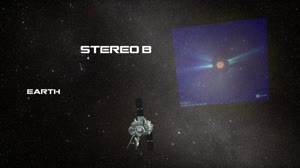
STEREO Solar Conjunction
NASA Goddard Space Flight Center
ScienceSpace
Clips are not offered for this film: NASA's media guidelines set the terms of its reuse themselves, not as a public licence.
Parts
About
Since February 2011, the two spacecraft of NASA's STEREO mission have been providing scientists with unprecedented views of the far side of the sun. Placed in an orbit that allows their perspective to changed over the eight years since their launch in 2008 (ck), the satellites are about to enter a new phase of their journey: a time when the bright light and heat of the sun will stand in the way of sending data back to Earth. This phase is a direct result of the orbits for STEREO, which is short for the Solar Terrestrial Relations Observatory. The spacecraft travel at different speeds. This means that over time, the satellites become increasingly out of sync, appearing from Earth's perspective to drift farther apart, able to observe first the sides and eventually the far side of the sun. For the first time ever, thanks to STEREO and near-Earth solar telescopes such as NASA’s Solar Dynamics Observatory the human race has had its first 360-degree view of the sun. The orbits have continued to cause the STEREO spacecraft's position to change, however, and now they are nearing each other once again, this time on the other side of the sun. During this period when the sun blocks Earth's view — a geometrical position known in astronomy as a superior conjunction — radio receivers on Earth will not be able to distinguish STEREO's signal from the sun's radiation. Communication with the spacecraft will cease and the satellites will both go into safe mode without collecting data for a…
Human-made No record of this work says a model made it. What this means.
More from NASA
 Film
Expedition 64 Air Space Museum and Museum of African American History and Culture
 Film
Watching the Friendly Skies - Eclipse Safety Tutorial
 Commercial
Inside KSC! for Dec. 27, 2021
 Educational
Expedition 70 Astronaut Furukawa Talks with JAXA Space Education Center Students - Nov. 23, 2023
 Film
Expedition 66 NG 16 Cygnus Release
 Film
Women at Glenn - 60 Seconds with Mary Lobo
 Commercial
CCP Boeing OFT ULA Live Launch Broadcast
 Film
SpaceCast Weekly March 1 2019
 Film
Expedition 70 71 Interviews With Flight Engineer Tracy Dyson 240226
 Film
Human Research Obstacle Course B-roll
 Film
SpaceCast Weekly - October 8, 2021
 Film