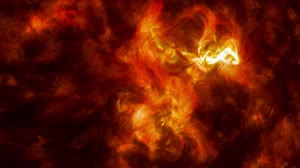
The Best Observed X-class Flare
NASA Goddard Space Flight Center
ScienceSpace
Clips are not offered for this film: NASA's media guidelines set the terms of its reuse themselves, not as a public licence.
Parts
About
On March 29, 2014 the sun released an X-class flare. It was observed by NASA's Interface Region Imaging Spectrograph, or IRIS; NASA's Solar Dynamics Observatory, or SDO; NASA's Reuven Ramaty High Energy Solar Spectroscopic Imager, or RHESSI; the Japanese Aerospace Exploration Agency's Hinode; and the National Solar Observatory's Dunn Solar Telescope located at Sacramento Peak in New Mexico. To have a record of such an intense flare from so many observatories is unprecedented. Such research can help scientists better understand what catalyst sets off these large explosions on the sun. Perhaps we may even some day be able to predict their onset and forewarn of the radio blackouts solar flares can cause near Earth – blackouts that can interfere with airplane, ship and military communications.
Human-made No record of this work says a model made it. What this means.
More from NASA
 Film
Expedition 64 Air Space Museum and Museum of African American History and Culture
 Film
Watching the Friendly Skies - Eclipse Safety Tutorial
 Commercial
Inside KSC! for Dec. 27, 2021
 Educational
Expedition 70 Astronaut Furukawa Talks with JAXA Space Education Center Students - Nov. 23, 2023
 Film
Expedition 66 NG 16 Cygnus Release
 Film
Women at Glenn - 60 Seconds with Mary Lobo
 Commercial
CCP Boeing OFT ULA Live Launch Broadcast
 Film
SpaceCast Weekly March 1 2019
 Film
Expedition 70 71 Interviews With Flight Engineer Tracy Dyson 240226
 Film
Human Research Obstacle Course B-roll
 Film
SpaceCast Weekly - October 8, 2021
 Film