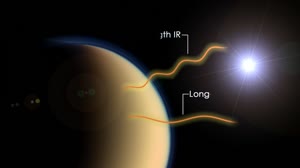
Propylene on Titan
NASA Goddard Space Flight Center
ScienceSpace
Clips are not offered for this film: NASA's media guidelines set the terms of its reuse themselves, not as a public licence.
Parts
About
With a thick atmosphere, clouds, a rain cycle and giant lakes, Saturn's large moon Titan is a surprisingly Earthlike place. But unlike on Earth, Titan's surface is far too cold for liquid water - instead, Titan's clouds, rain, and lakes consist of liquid hydrocarbons like methane and ethane (which exist as gases here on Earth). When these hydrocarbons evaporate and encounter ultraviolet radiation in Titan's upper atmosphere, some of the molecules are broken apart and reassembled into longer hydrocarbons like ethylene and propane. NASA's Voyager 1 spacecraft first revealed the presence of several species of atmospheric hydrocarbons when it flew by Titan in 1980, but one molecule was curiously missing - propylene, the main ingredient in plastic number 5. Now, thanks to NASA's Cassini spacecraft, scientists have detected propylene on Titan for the first time, solving a long-standing mystery about the solar system's most Earthlike moon.
Human-made No record of this work says a model made it. What this means.
More from NASA
 Film
Expedition 64 Air Space Museum and Museum of African American History and Culture
 Film
Watching the Friendly Skies - Eclipse Safety Tutorial
 Commercial
Inside KSC! for Dec. 27, 2021
 Educational
Expedition 70 Astronaut Furukawa Talks with JAXA Space Education Center Students - Nov. 23, 2023
 Film
Expedition 66 NG 16 Cygnus Release
 Film
Women at Glenn - 60 Seconds with Mary Lobo
 Commercial
CCP Boeing OFT ULA Live Launch Broadcast
 Film
SpaceCast Weekly March 1 2019
 Film
Expedition 70 71 Interviews With Flight Engineer Tracy Dyson 240226
 Film
Human Research Obstacle Course B-roll
 Film
SpaceCast Weekly - October 8, 2021
 Film