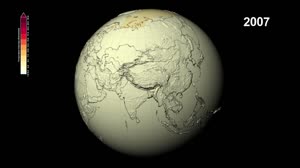
IPCC Projections of Temperature and Precipitation in the 21st Century
NASA Goddard Space Flight Center
ScienceSpace
Clips are not offered for this film: NASA's media guidelines set the terms of its reuse themselves, not as a public licence.
Parts
About
New data visualizations from the NASA Center for Climate Simulation and NASA's Scientific Visualization Studio show how climate models – those used in the new report from the United Nations' Intergovernmental Panel on Climate Change (IPCC) – estimate how temperature and precipitation patterns could change throughout the 21st century. For the IPCC's Physical Science Basis and Summary for Policymakers reports, scientists referenced an international climate modeling effort to study how the Earth might respond to four different scenarios of how much carbon dioxide and other greenhouse gases would be emitted into the atmosphere throughout the 21st century. The Summary for Policymakers, the first official piece of the group's Fifth Assessment Report, was released Fri., Sept. 27. That modeling effort, called the Coupled Model Intercomparison Project Phase 5 (CMIP5), includes dozens of climate models from institutions around the world, including from NASA's Goddard Institute for Space Studies. To produce visualizations that show temperature and precipitation changes similar to those included in the IPCC report, the NASA Center for Climate Simulation calculated mean model results for each of the four emissions scenarios. The final products are visual representations how much temperature and precipitation patterns would change through 2100 compared to the historical average from the end of the 20th century. The changes shown compare the model projections to the average temperature…
Human-made No record of this work says a model made it. What this means.
More from NASA
 Film
Expedition 64 Air Space Museum and Museum of African American History and Culture
 Film
Watching the Friendly Skies - Eclipse Safety Tutorial
 Commercial
Inside KSC! for Dec. 27, 2021
 Educational
Expedition 70 Astronaut Furukawa Talks with JAXA Space Education Center Students - Nov. 23, 2023
 Film
Expedition 66 NG 16 Cygnus Release
 Film
Women at Glenn - 60 Seconds with Mary Lobo
 Commercial
CCP Boeing OFT ULA Live Launch Broadcast
 Film
SpaceCast Weekly March 1 2019
 Film
Expedition 70 71 Interviews With Flight Engineer Tracy Dyson 240226
 Film
Human Research Obstacle Course B-roll
 Film
SpaceCast Weekly - October 8, 2021
 Film