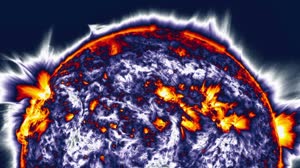
Gradient Sun
NASA Goddard Space Flight Center
ScienceSpace
Clips are not offered for this film: NASA's media guidelines set the terms of its reuse themselves, not as a public licence.
Parts
About
Watching a particularly beautiful movie of the sun helps show how the lines between science and art can sometimes blur. But there is more to the connection between the two disciplines: science and art techniques are often quite similar, indeed one may inform the other or be improved based on lessons from the other arena. One such case is a technique known as a "gradient filter" — recognizable to many people as an option available on a photo-editing program. Gradients are, in fact, a mathematical description that highlights the places of greatest physical change in space. A gradient filter, in turn, enhances places of contrast, making them all the more obviously different, a useful tool when adjusting photos. Scientists, too, use gradient filters to enhance contrast, using them to accentuate fine structures that might otherwise be lost in the background noise. On the sun, for example, scientists wish to study a phenomenon known as coronal loops, which are giant arcs of solar material constrained to travel along that particular path by the magnetic fields in the sun's atmosphere. Observations of the loops, which can be more or less tangled and complex during different phases of the sun's 11-year activity cycle, can help researchers understand what's happening with the sun's complex magnetic fields, fields that can also power great eruptions on the sun such as solar flares or coronal mass ejections. The images here show an unfiltered image from the sun next to one that has…
Human-made No record of this work says a model made it. What this means.
More from NASA
 Film
Expedition 64 Air Space Museum and Museum of African American History and Culture
 Film
Watching the Friendly Skies - Eclipse Safety Tutorial
 Commercial
Inside KSC! for Dec. 27, 2021
 Educational
Expedition 70 Astronaut Furukawa Talks with JAXA Space Education Center Students - Nov. 23, 2023
 Film
Expedition 66 NG 16 Cygnus Release
 Film
Women at Glenn - 60 Seconds with Mary Lobo
 Commercial
CCP Boeing OFT ULA Live Launch Broadcast
 Film
SpaceCast Weekly March 1 2019
 Film
Expedition 70 71 Interviews With Flight Engineer Tracy Dyson 240226
 Film
Human Research Obstacle Course B-roll
 Film
SpaceCast Weekly - October 8, 2021
 Film